From sloths to clownfish: 20 examples of teamwork across the animal kingdom
From sloths to clownfish: 20 examples of teamwork across the animal kingdom
When Charles Darwin presented the theory of evolution in the late 19th century, other biologists began to idealize the natural world as a realm driven by competition. Every living creature is striving to survive by any means necessary, these scientists thought, and it will happily push out, feed on, or otherwise out-compete any other creature that stands in its way. In actuality鈥攁s anyone who's fallen down a "cute animals become friends" YouTube rabbit hole knows鈥攖he natural world is far kinder and far more complicated than the basic tenets of evolution would have it seem.
From the biggest whales to the tiniest fungi, living creatures depend upon each other to survive. Sure, one species "depending on" another can often mean that the first species needs to eat the second. But there are also flowering plants depending upon honeybees to spread their seeds, ants depending upon trees to provide homes for their colonies, corals depending upon microscopic algae to give them energy through photosynthesis, and even sea worms depending upon bacteria to help break down the bones of dead animals.
Scientists call a dependent relationship like this mutualism: two or more species that mutually benefit each other. Sometimes these relationships are more like casual friendships, where one species can help each other out occasionally, and other times they're more like intense marriages, where both species need each other to survive. Mutualisms are important to biologists who look to the past and those who look to the future because studying these behavioral interactions can both provide clues as to how species evolved and help conservation researchers understand how to best protect endangered populations.
For this story, 麻豆原创 scoured the scientific literature (and surveyed a few of our science communication friends) to compile a list of 20 incredible mutualisms showcasing how different life forms can work together. Read on to learn about friendships from the plains of the Serengeti to the bottom of the ocean.
Zebra and wildebeests
Banding together to avoid predators is a useful tactic, even for animals as big as zebras and wildebeests. On the Serengeti, these two herbivores can , because zebras like to eat longer, tougher grasses while wildebeests prefer shorter, more tender specimens. Plus, zebras, wildebeests, and impalas, a type of antelope, can all recognize each other鈥檚 warning calls and help each other escape danger. Scientists are still investigating this relationship to determine whether it is truly a mutualism or simply a convenient habitat-sharing interaction, but either way, it鈥檚 clear that the Serengeti鈥檚 plant-eaters are able to live in harmony.
Langur monkeys and chital deer
In central India, langur monkeys and chital deer . The langurs, long-haired gray monkeys with great eyesight, keep a look-out in the trees while the chital deer, brown spotted deer with an impressive sense of smell, watch out for predators on the ground. The deer also eat fruit that the langurs drop from the canopy.
Gal谩pagos birds and flowering plants
In oceanic island habitats like the Gal谩pagos, biodiversity is often limited鈥攊n other words, there just aren鈥檛 that many different species present. Plants in such environments often invite lots of pollinators to help them reproduce while pollinators benefit from less picky eating. This trend leads some bird species on the Gal谩pagos islands to act as double mutualists: These birds consume nectar from plants鈥� flowers, and then later consume the very fruit that resulted from their own pollination.
Jens Olesen and colleagues, who , suggest that the conservation focus for island biologists should be on whole environments, rather than on particular species, in order to preserve these complex networks.
Pawpaw trees and zebra swallowtail butterflies
Zebra swallowtails, beautiful black-and-white-striped butterflies native to the eastern U.S. and Canada, are the state butterfly of Tennessee. For reproduction, these butterflies rely on pawpaws, a group of understory trees with large, yellow-green fruit. Zebra swallowtail caterpillars , because they ingest compounds in the trees鈥� leaves that are poisonous to many predators. In return, the butterflies help the trees reproduce through pollination.
Duroia trees and lemon ants
While acacia ants protect acacia trees, lemon ants protect duroia trees, flowering plants in the understory of the Amazon rainforest. A particular species of lemon ant, called Myrmelachista schumanni, nests in a particular species of duroia tree, called Duroia hirsuta. The ants are so determined not to let competitors threaten their nests that they produce formic acid, a deadly compound, and poison any other trees that come into the area. This creates areas of the forest that are populated solely by duroia trees. Indigenous people living in the Amazon called these strands "devil's gardens" and believed they were created by evil forest spirits.
[Pictured: The swollen leaves and thin stem of a myrmecophyte from the forests of the Andaman Islands. One of the leaves has been sectioned.]
Acacia trees and acacia ants
Like the yucca moths, acacia ants evolved alongside a group of trees. These ants depend on acacia trees for shelter; in fact, at the base of acacia leaves, lay their eggs inside, and take nectar from the nearby leaves. When an ant colony grows large enough, every thorn of an acacia can become inhabited. In return, the ants defend their trees against rival insects and other predators.
Yucca plants and yucca moths
You know a friendship is special when two species groups share the same name. Yuccas, a group of tropical trees and shrubs known for their tough, sword-shaped leaves, and yucca moths, a group of small, nondescript moths, actually in a process biologists call coevolution. The yucca plants rely on the moths for pollination, while the larvae of some moth species feed exclusively on yucca seeds.
Oxpeckers, rhinos, and zebra
Another small bird, big eater relationship can be found on the plains of sub-Saharan Africa: Oxpeckers perch on the backs of big herbivores, namely rhinoceroses and zebras, and eat the ticks and flies they find. While this relationship has long been hailed as a classic mutualism example, , as Kat Eschner reported in the Smithsonian. Oxpeckers not only eat ticks from their hosts鈥� backs, they also drink blood from the animals鈥� sores鈥攎aking it harder for those wounds to heal.
Plover birds and Nile crocodiles
While wrasse fish have some preferences for which larger animals they鈥檇 like to clean, they are generally equal-opportunity feeders. Egyptian plover birds, on the other hand, have a mutualistic relationship with one specific predator: the Nile crocodile. When a Nile crocodile gets food stuck in its teeth, it will sit in the sun with its mouth open, and to pick the extra food out. The crocodile is thus protected from rotting food and infections.
Cleaner wrasses and larger fish
Exploring a coral reef is a hazardous task; not only do fish have to avoid big predators, they also risk having their scales clogged by smaller, parasitic creatures and ocean gunk. When the situation gets particularly dire, reef fish visit run by blue-streaked cleaner wrasses and other similar species. At these "cleaning stations," basically the aquatic equivalent of a dentist's office, wrasses eat the parasites, displaced scales, and other gunk from their so-called clients. The larger fish get spa treatment while the wrasse gets a meal.
Clownfish and sea anemones
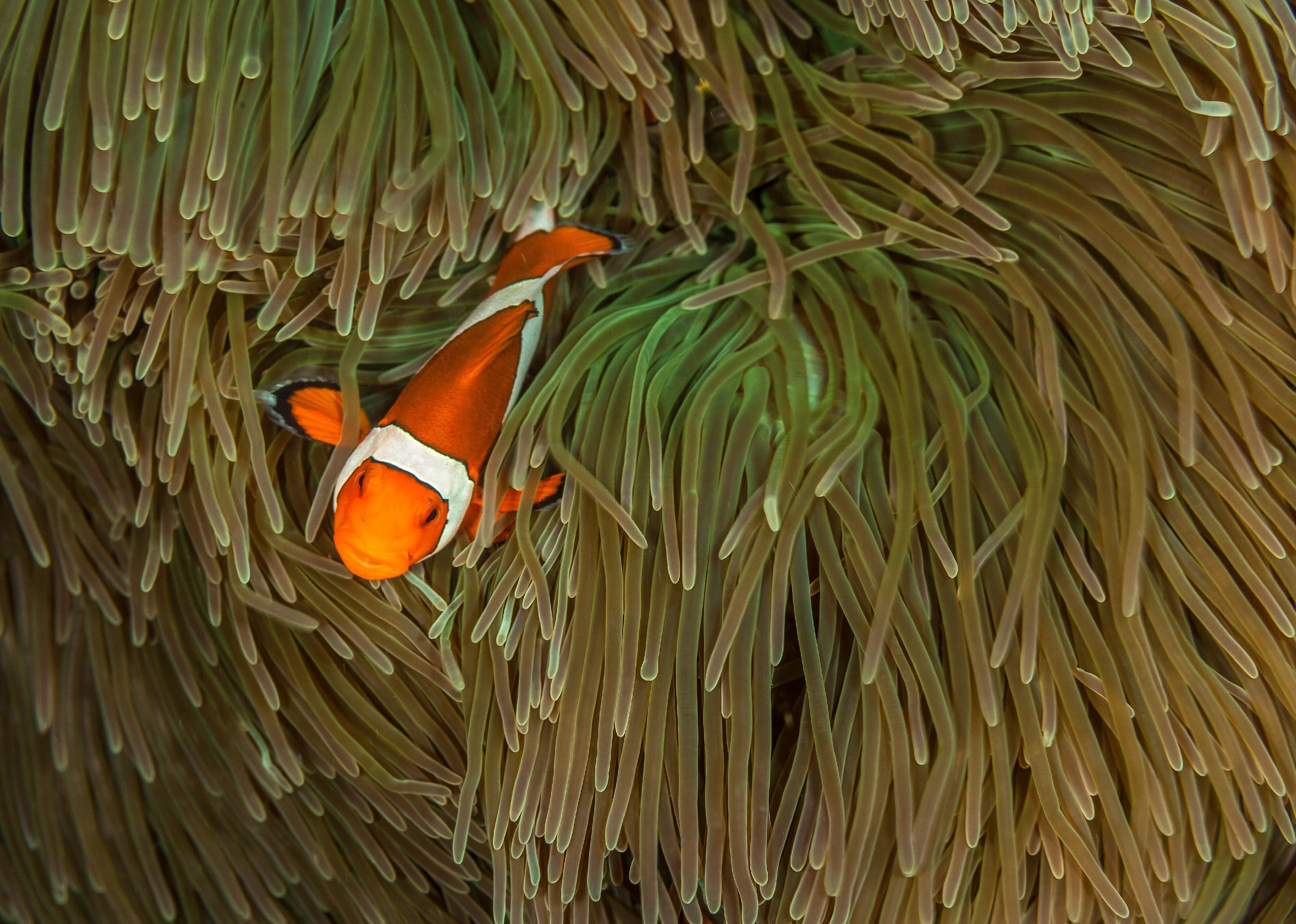
Protection from predators is a common theme in nature鈥檚 collaborations. Clownfish, recognizable as the titular character from 鈥淔inding Nemo,鈥� have that allows them to live in anemones, flowering ocean plants with poisonous tentacles. The clownfish enjoy a safe haven from the open ocean while defending the anemones from other fish that would feed on the plants.
Sea urchins and carrier crabs
How did carrier crabs (Dorippe frascone) get their name? The moniker comes from a mutualism: These crabs have five pairs of legs, including an especially strong back pair which allows them to carry other sea creatures鈥uch as deadly sea urchins. An urchin鈥檚 spine protects a carrier crab from predators, while the urchin enjoys a ride to new feeding grounds. You can see this collaboration in action on .
[Pictured: Carrier crab, Dorippe frascone, carrying an upside-down jellyfish, Flores Indonesia.]
Osedax annelid worms and bacteria
Speaking of burrowing: Osedax annelid worms, also called boneworms and zombie worms, eat by digging into the bones of dead animals on the seafloor. These worms have neither mouths nor stomachs, so they rely on a group of bacteria called Oceanospirillales to degrade the bones down into materials the worms can process. The bacteria, meanwhile, get as Jessica Carilli put it in an article for Nature鈥檚 Scitable blog.
[Pictured: Osedax antarcticus.]
Goby fish and pistol shrimp
Animal partnership can happen beneath the waves as well as on land. In the Atlantic, Pacific, and Indian oceans, help each other survive. The shrimp builds shelter for both creatures, digging a burrow in the sand on the seafloor, while the goby keeps a lookout for predators with its superior eyesight. Partnerships between individual shrimps and gobies form when the animals are young and usually continue into both species鈥� adulthood.
Sloths, pyralid moths, and algae
Three-toed sloths spend most of their lives eating and napping high in the trees鈥攅xcept for a few hours each week when they descend to the ground to defecate. A slow climb down a tree trunk and return back to a leafy perch costs a sloth a lot of energy and exposes it to predators, making defecation the #1 cause of sloth mortality. So, why do sloths risk everything to climb down, rather than just letting go from high in the air?
The answer is tied to a complex partnership between sloths, algae living on the sloths' hairy backs, and several species of pyralid moth, as . The sloths climb down to the forest floor in order to facilitate the moth life cycle, and the moths bring nutrients from the soil to the sloths' backs, in turn facilitating the growth of algae, which the sloths and moths both like to eat.
Panic grass and plant fungus
Panic grass, a flowering grass group, is found across central and eastern America. But one special variety (scientific name Dichanthelium lanuginosum var. thermale) is able to grow in the geothermal soils at Yellowstone National Park, where temperatures get as high as 150 degrees Fahrenheit (65 degrees Celsius). The fungus species Curvularia protuberata makes this extreme lifestyle possible by , while the grass gives the fungus nutrients and a place to live.
Ruminants and gut bacteria
You might remember from high school science classes that cows have four stomachs. Cows, like sheep, goats, and buffalo, are part of a group called ruminants, large mammals with unique digestive systems that are able to break down grass and other coarse plant materials. And what do these unique digestive systems rely upon? Microorganisms, of course. Bacteria in ruminants鈥� stomachs for the animals while taking some of the nutrients in return.
Corals and algae
Corals, those vibrant animals that make up coral reefs, are another animal group that depends on a . The algae, called zooxanthellae, are able to conduct photosynthesis (the plant-cell process that makes sugar from sunlight), and they provide the corals with food in return for a safe place to live. Zooxanthellae also give coral reefs their distinctive bright colors; in fact, when corals become stressed, the animals push the algae off and turn white in a phenomenon known as coral bleaching.
Lichen-forming fungi and algae
Lichen: they鈥檙e little plants that grow on trees and rocks, right? Wrong. Lichen are actually formed by collaboration; colonies of microscopic algae live inside of fungi, with each organism providing the other with nutrients. And the interaction is even more complex than that, as : some lichen colonies are harboring multiple fungi species, and scientists are still working to understand the role of each one.
Cells, mitochondria, and chloroplasts
The last mutualism in this story actually helped build plant and animal life as we know it. Biologists hypothesize that both the mitochondrion, a tiny apparatus in our cells that makes energy (also known as the "powerhouse of the cell"), and the chloroplast, a similar apparatus specific to plant cells that turns the sun's light into food, were both once independent cells.
These independent cells were engulfed by host cells, and inside their hosts, tiny invaders took advantage of the new, safer living environment while providing these hosts with energy. That partnership, which biologists call the , evolved into the complex eukaryotic cells that make up our bodies today.