The second Jan. 6 hearing by the numbers
The second Jan. 6 hearing by the numbers
The second hearing by the took place on the morning of June 13, focusing heavily on the numbers of the 2020 election. Chairman Bennie G. Thompson, a congressman from Mississippi, opened the day's proceedings saying, "The . For the most part, the numbers don't lie. But if something doesn't add up with the numbers, you go to court to get a resolution and that's the end of the line. We accept those results. That's what it means to respect the rule of law. … [But] Donald Trump didn't."
While the first hearing previewed what will be at least seven more hearings to come, the second dug into former President Donald Trump's allegations that the 2020 presidential election was fraudulent. The hearing was delayed because one of the early witnesses, Bill Stepien, a campaign manager for Trump, had to return home due to his wife going into labor. But the proceedings eventually commenced, using previous interviews—audio and video—with Stepien, along with live testimony from four other witnesses.
Read on to learn what the second hearing of the committee revealed as Â鶹ԭ´´ traces its revelations by the numbers.
You may also like: The first Jan. 6 hearing by the numbers
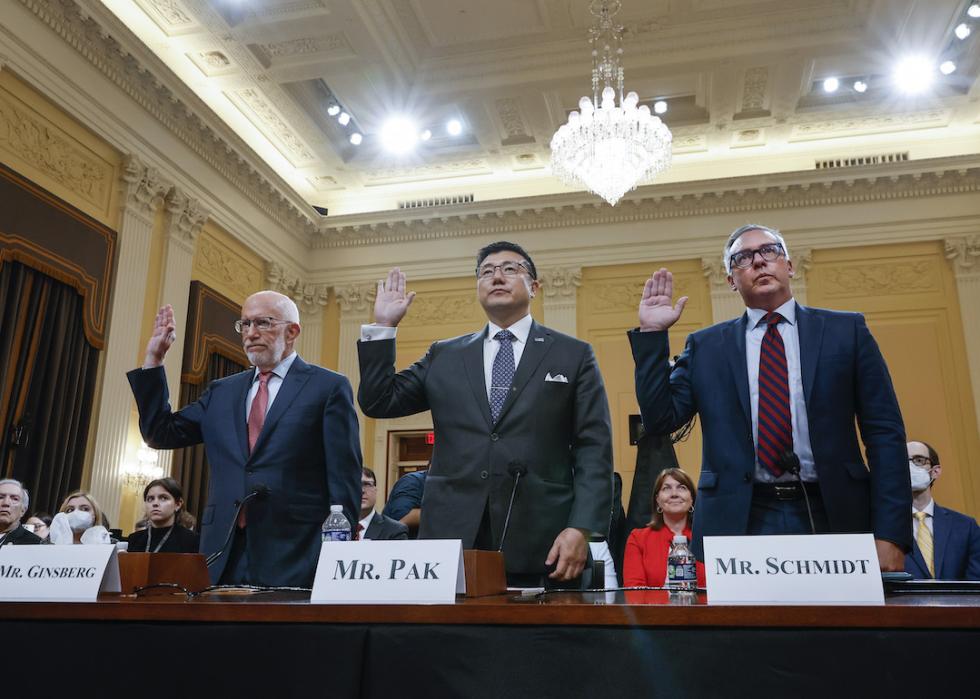
5 witnesses were scheduled to testify in the second hearing
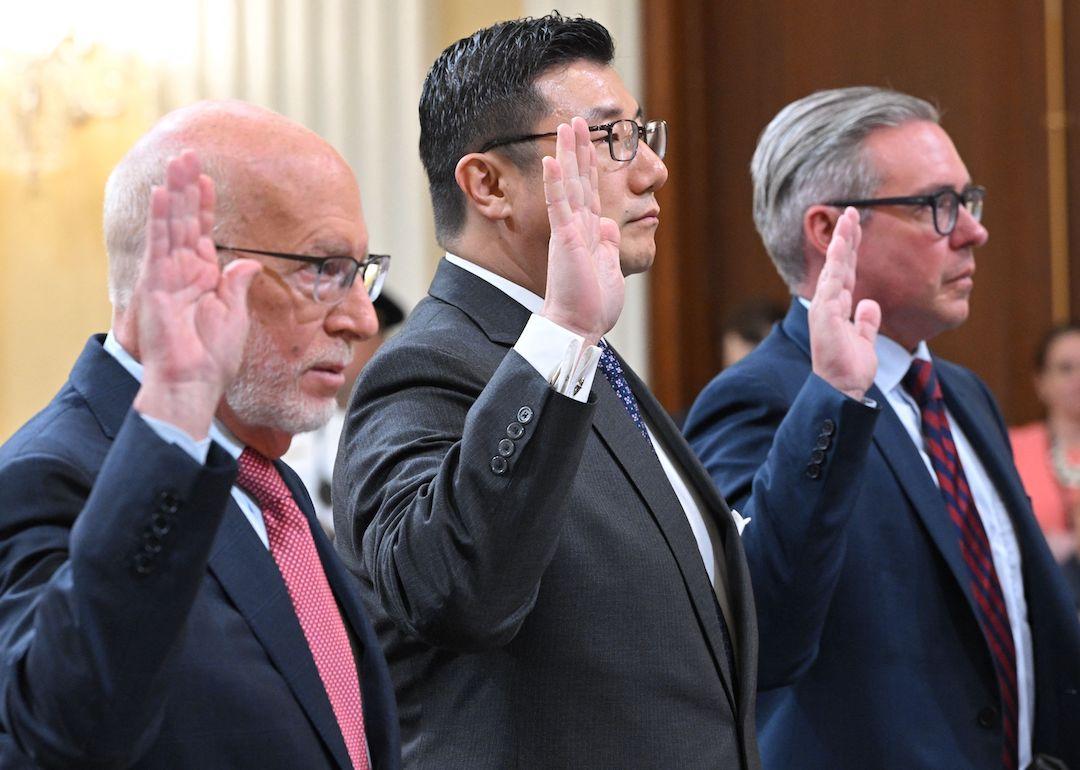
In addition to Bill Stepien, who didn’t testify due to his family emergency, the second hearing included testimony from four other witnesses: former Fox News commentator and editor Chris Stirewalt; U.S. Attorney for the Northern District of Georgia during the Trump administration Byung J. Pak (pictured middle); Washington elections lawyer Ben Ginsberg (pictured left); and Al Schmidt (pictured right), a former Republican city commissioner in Philadelphia.
3 of the 5 key states needed to flip for Trump to win
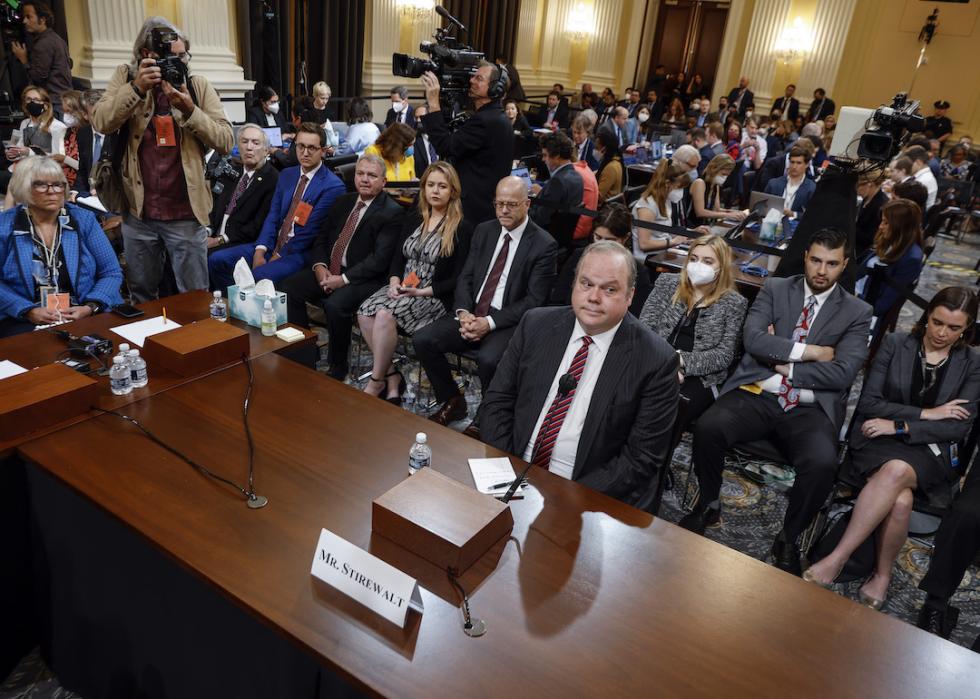
Stirewalt, the first to testify at the June 13 hearing, discussed Fox News’ decision to call Arizona for President Joe Biden early on the night of Nov. 3, 2020. It was a turning point in the evening as Arizona was one of five key states in determining the results of the election—the others being Wisconsin, Michigan, Pennsylvania, and Georgia.
“We knew it would be significant,” Stirewalt (pictured here) said of the network’s decision to make the call.
Stirewalt said Trump would have needed to win three of those five key states in a recount in order to win the election. The chances of that happening? “You’re better off to play the Powerball than to have that come in,” said Stirewalt
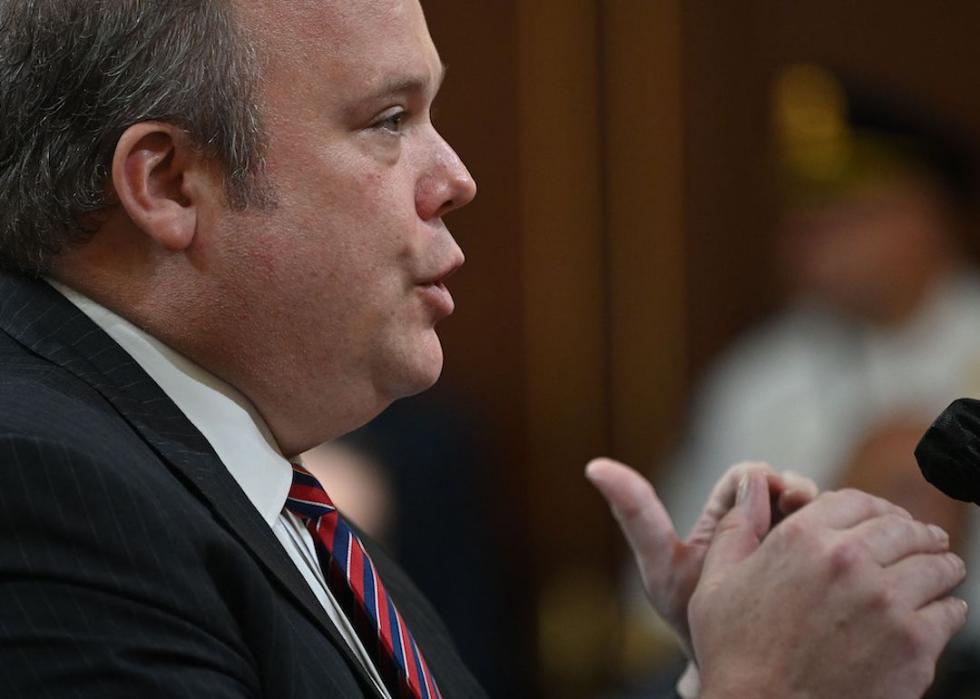
Tens of thousands of votes were needed for Trump to win in a recount
Stirewalt explained that a recount could historically potentially shift hundreds of votes, but it wouldn’t change the thousands of votes Trump needed to win in those key swing states.
“In a recount, you’re talking about hundreds of votes,” Stirewalt said. “Normally, you’re talking about hundreds of votes, maybe 300 votes that will change.” But in this case, as much as 33 times that was needed. “When we think about calling a race, one of the things we think about is, is it outside the margin of a recount,” Stirewalt continued. “When we think about that margin, we think about, in modern history, you’re talking about 1,000 votes,1,500 votes, at the way, way outside.”
In his later testimony, Republican election lawyer Ben Ginsberg also asserted the “2020 election was not close,” adding, “The most narrow margin was 10,000 and something in Arizona and you just don't make up those sorts of numbers in recounts.”
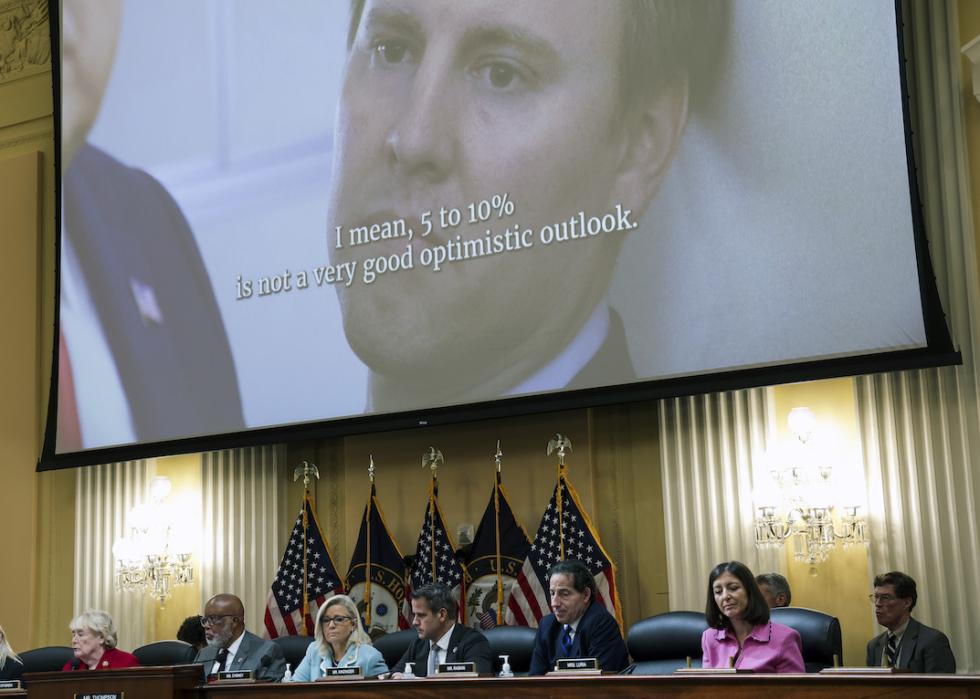
5-10% chance of Trump winning, according to his campaign manager
In a pre-recorded interview with the committee, Bill Stepien—who joined the Trump campaign as manager 115 days before the 2020 election—talked about his experience with the former president and his close confidants.
“The day I was hired was President Trump’s low point in the daily average polling against President Biden,” Stepien (pictured here) said. “Most of my time was spent fixing the things that could be fixed.”
“There was a great deal wrong with the campaign,” he added. “It was structurally and fiscally deficient.”
Toward the end of the week of the election, Stepien said he told the then-president that the “chances for success” were 5% to 10%, based on recounts. “5 to 10% is not a very good, optimistic outlook,” Stepien recalled, noting the situation was “very, very, very bleak.”
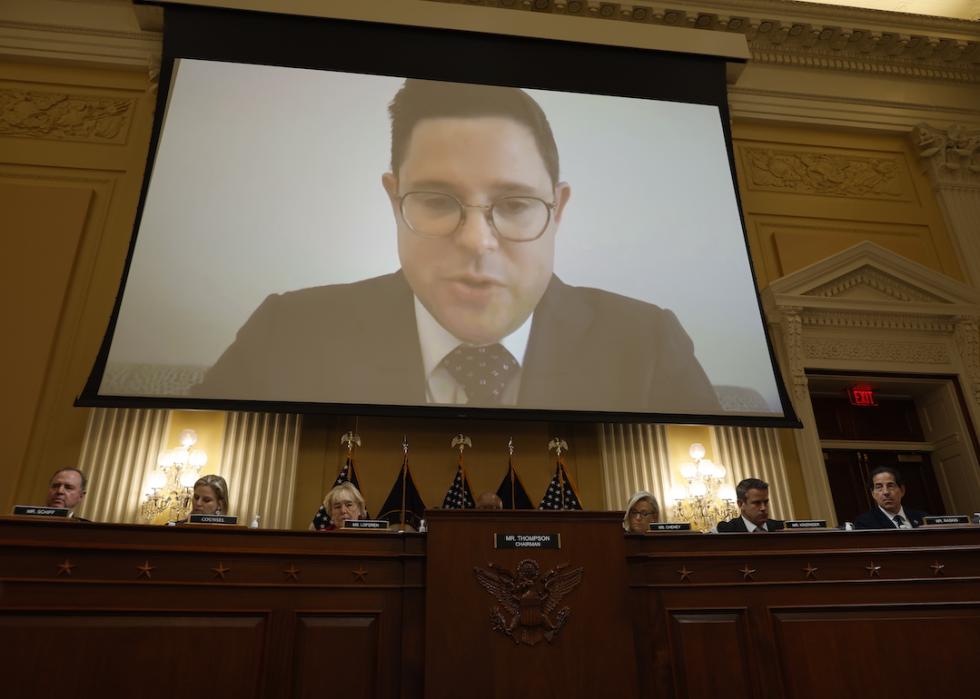
Thousands of citizens overseas who cast their vote in Arizona were alleged to be 'illegal citizens' of the US
Bill Stepien also addressed a claim that there were thousands of illegal citizens voting in Arizona. "This wild claim was thrown out, which, you know, on its face didn't seem, you know, realistic or possible to me," he recalled.
Stepien said Alex Cannon (pictured here), a former Trump campaign lawyer, was tasked with investigating these claims and what he found was that these were American citizens voting overseas, not illegal citizens. "The reality of that was not illegal citizens voting in the election; I think it was like overseas voters voting in the election, so obviously people who were eligible to vote," Stepien said.
You may also like: 25 ways America changed during the Trump administration
8,000 dead people were alleged to have voted in Pennsylvania in another false claim
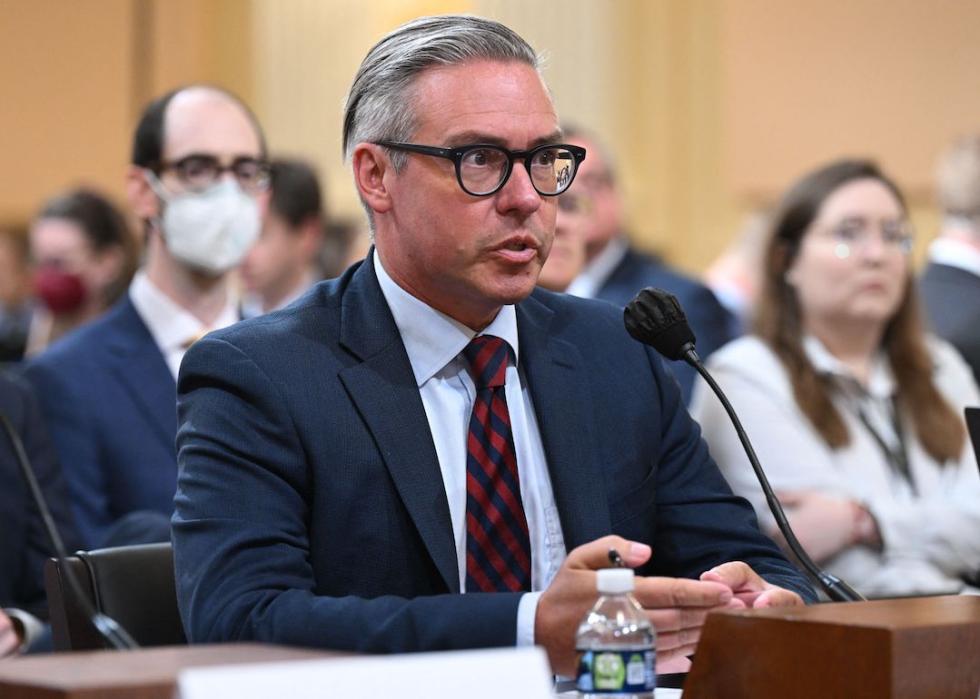
Another false claim that came out of the Trump camp was that more than 8,000 votes in Pennsylvania were from dead people. During his testimony, Al Schmidt (pictured here), a former Republican city commissioner in Philadelphia, said, “Not only was there not evidence of 8,000 dead voters voting in Pennsylvania, there wasn't evidence of eight.”
Schmidt also cited the threats hurled at him after Trump tweeted: “A guy named Al Schmidt, a Philadelphia Commissioner and so-called Republican (RINO), is being used big time by the Fake News Media to explain how honest things were with respect to the Election in Philadelphia. He refuses to look at a mountain of corruption & dishonesty. We win!”
After that tweet, Schmidt said he received threats that targeted members of his family, showed pictures of his home, and included sentiments like, “You’re what the Second Amendment is for.”
A reported 68% error rate in voting machines in Michigan was .0063% in reality
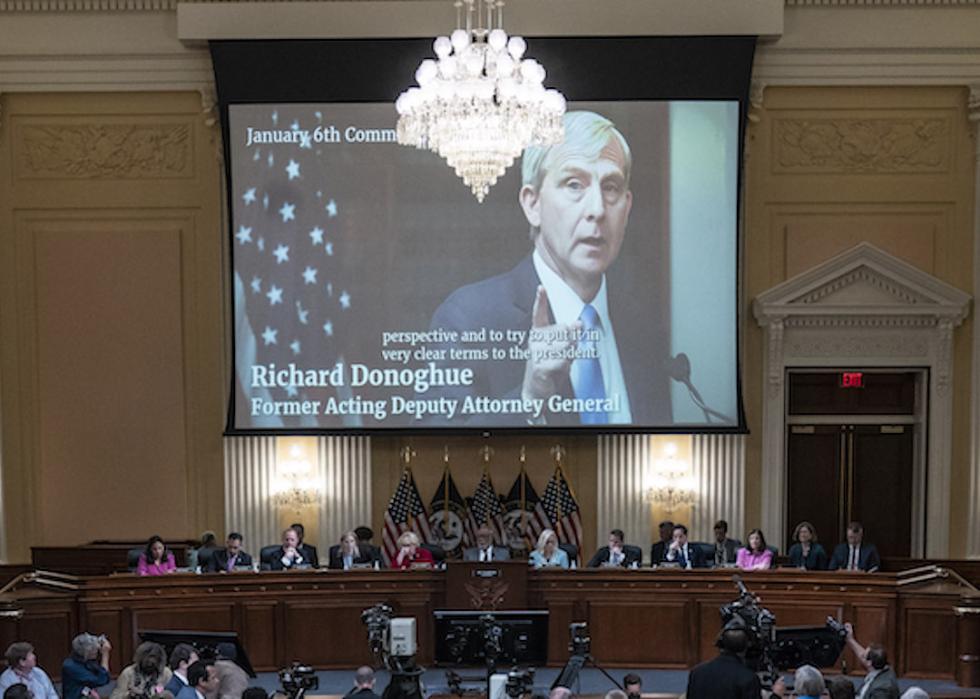
The committee also played audio from their interview with Richard Donoghue (pictured here), former acting deputy attorney general, who recalled investigating another claim of fraud that proved to be unsubstantiated. “I tried to again put this into perspective and further put it in clear terms to the president,” he recalled. “I said something to the effect of, ‘Sir, we’ve done dozens of investigations, hundreds of interviews—the major allegations are not supported by the evidence. We looked at Georgia, Pennsylvania, Michigan, Nevada; we’re doing our job. Much of the info you’re getting is false.’”
He specifically cited a claim about the voting machine “error rate” in Michigan. “I went into, for instance, this thing from Michigan—this report about a 68% error rate. The reality is it was only .0063%.” Though Donoghue said the president accepted that, he added that Trump “would move to another allegation.”
$250 million was raised by Trump after the election
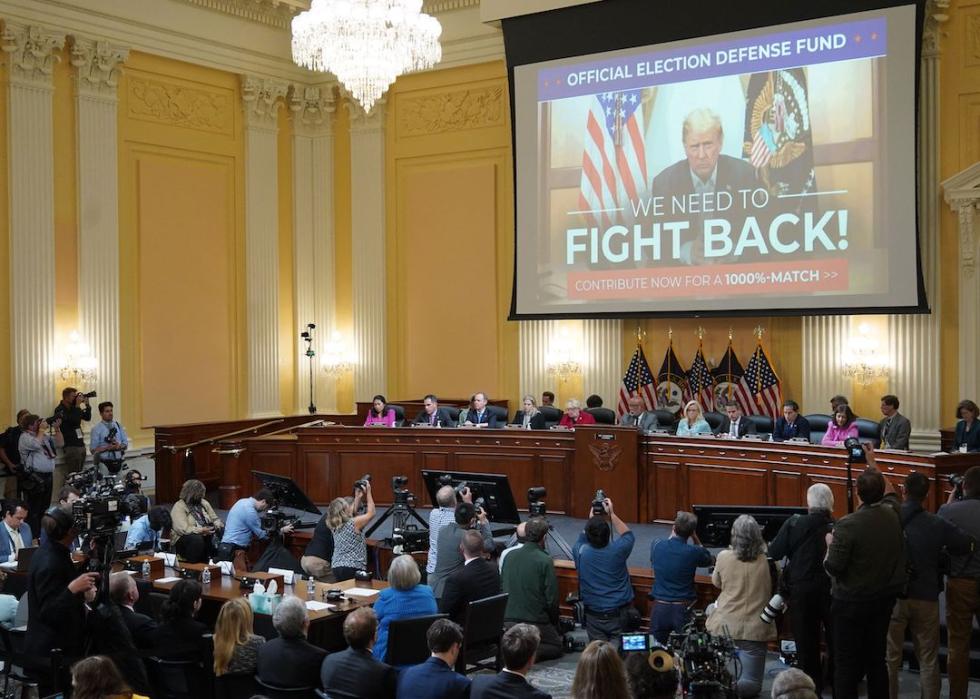
In a final video that aired at the end of the second hearing, Amanda Wick, senior investigative counsel with the committee, explained how the Trump campaign was sending up to 25 emails per day to small-dollar donors, asking for funds to support the supposed “Official Election Defense Fund.” According to the investigation, however, no such fund existed. “I don’t believe there was actually a fund called the Election Defense Fund,” Hanna Allred, a former Trump campaign staffer, said in the video.
Wick said Trump and his allies raised $250 million dollars, nearly $1 million of which was donated in the week after the election. But that money, Wick said, did not go to supporting the election-related litigation—rather it helped support the . The committee found that $1 million went to the Conservative Partnership Institute, another million was donated to the America First Policy Institute, nearly $205,000 went to the Trump Hotel Collection, and $5 million was donated to Event Strategies Inc.
According to Wick, 30 minutes after the last fundraising email for the “Official Election Defense Fund” was sent, the Capitol was breached on Jan. 6.
2 teams emerged from the Trump camp
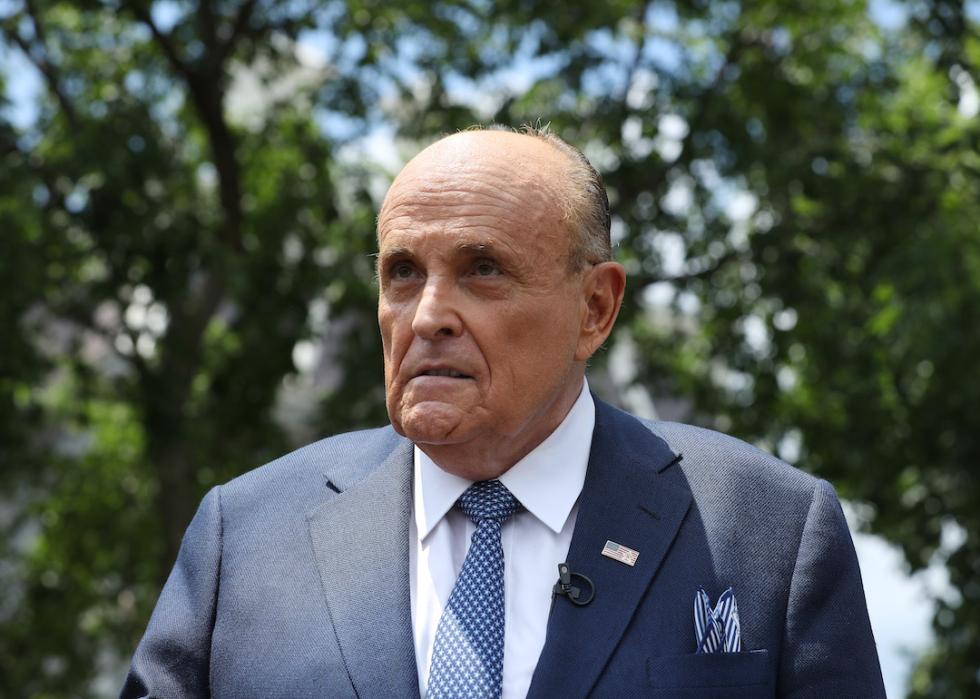
Bill Stepien said as allegations of a fraudulent election continued to grow while evidence failed to support it, two teams emerged in the Trump camp: Stepien’s team and Trump's lawyer, Rudy Giuliani’s team. “There were two groups. We called them kind of my team and Rudy’s team. I didn’t mind being characterized as being part of ‘Team Normal,’ as reporters kind of started to do around that point in time,” Stepien said.
“I’ve been doing this for a long time—25 years and I’ve spanned political ideologies from Trump to [John] McCain to [George W.] Bush to [Chris] Christie. I can work under a lot of circumstances for a lot of varied candidates and politicians,” he continued. “I think along the way, I’ve built up a pretty good—I hope—reputation for being honest and professional. I didn’t think what was happening was necessarily honest or professional at that point in time, so that led to me stepping away.
61 of the 62 post-election lawsuits Trump's camp brought forth were losses
Trump's team has brought forth 62 lawsuits since the 2020 election, which resulted in 61 losses and a single victory, which California Congresswoman Zoe Lofgren said would not have affected the outcome of the election.
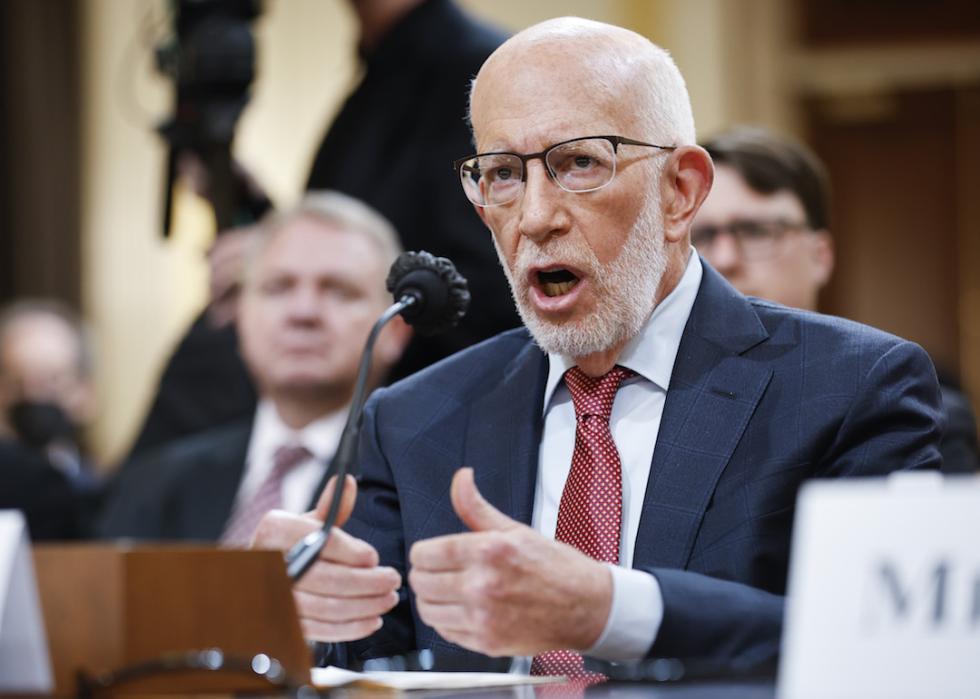
In her questioning of GOP election lawyer Ben Ginsberg (pictured here), he explained that he's looked at those 62 lawsuits "that include more than 180 counts" and "about half of those cases were dismissed at the procedural stage." The reason for the dismissals, Ginsberg said, was there was "no credible evidence of fraud produced by the Trump campaign or his supporters."
On top of that, he added, in cases that were not immediately dismissed, "in no instance did a court find that the charges of fraud were real."
The next hearing is set for June 15 at 10 a.m. ET.
You may also like: Experts rank the best US presidents of all time