U.S. counties most at risk for flooding in 2024
was produced by and reviewed and distributed by 麻豆原创 Media.
U.S. counties most at risk for flooding in 2024
Which parts of the U.S. are most vulnerable to flood damage?
With flood season (June to November) ramping up, ranked this year's counties that are most at risk for flooding.
We compared over 940 counties with a relatively moderate to very high flood risk according to FEMA. Each county's risk and expected annual loss from riverine and coastal flooding was considered. We also looked at the share of populations of children, elderly, and residents in mobile homes, in addition to local demand for flood insurance.
See where your county landed in the ranking below. To learn how we ranked the counties, see our .
County Rankings
See how each county fared:
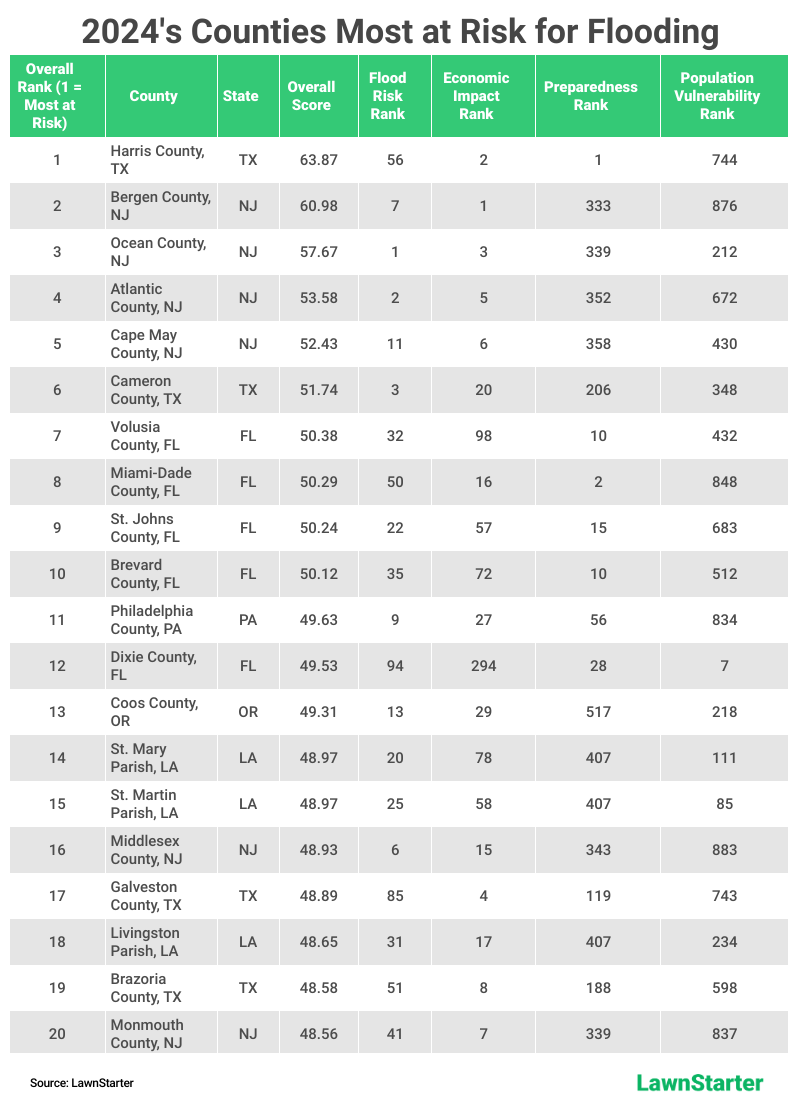
Top 5 Close Up
No. 1: Harris County, Texas | 3 Biggest Cities: Houston, Pasadena, Pearland
- Overall Score: 63.87
- Riverine Flooding Risk Score: 100 | Rank: 1
- Coastal Flooding Risk Score: 73.84 | Rank: 131
- Expected Annual Loss from Riverine Flooding: $676.2 million | Rank: 1
- Expected Annual Loss from Coastal Flooding: $829,391 | Rank: 142
- Average Monthly Google Searches for Terms Related to Flood Insurance: 880 | Rank: 1
No. 2: Bergen County, New Jersey | 3 Biggest Cities: Hackensack, Fort Lee, Fair Lawn
- Overall Score: 60.98
- Riverine Flooding Risk Score: 95.16 | Rank: 153
- Coastal Flooding Risk Score: 100 | Rank: 1
- Expected Annual Loss from Riverine Flooding: $7.4 million | Rank: 132
- Expected Annual Loss from Coastal Flooding: $210.4 million | Rank: 1
- Average Monthly Google Searches for Terms Related to Flood Insurance: 70 | Rank: 40
No. 3: Ocean County, New Jersey | 3 Biggest Cities: Toms River, Lakewood, Point Pleasant
- Overall Score: 57.67
- Riverine Flooding Risk Score: 98.09 | Rank: 61
- Coastal Flooding Risk Score: 99.6 | Rank: 3
- Expected Annual Loss from Riverine Flooding: $22 million | Rank: 37
- Expected Annual Loss from Coastal Flooding: $100.5 million | Rank: 2
- Average Monthly Google Searches for Terms Related to Flood Insurance: 50 | Rank: 57
No. 4: Atlantic County, New Jersey | 3 Biggest Cities: Vineland, Atlantic City, Glassboro
- Overall Score: 53.58
- Riverine Flooding Risk Score: 97.55 | Rank: 78
- Coastal Flooding Risk Score: 99.8 | Rank: 2
- Expected Annual Loss from Riverine Flooding: $11.2 million | Rank: 84
- Expected Annual Loss from Coastal Flooding: $77.5 million | Rank: 3
- Average Monthly Google Searches for Terms Related to Flood Insurance: 20 | Rank: 132
No. 5: Cape May County, New Jersey | 3 Biggest Cities: Ocean City, Villas, Cape May Court House
- Overall Score: 52.43
- Riverine Flooding Risk Score: 92.43 | Rank: 239
- Coastal Flooding Risk Score: 99.4 | Rank: 4
- Expected Annual Loss from Riverine Flooding: $5 million | Rank: 204
- Expected Annual Loss from Coastal Flooding: $64.7 million | Rank: 4
- Average Monthly Google Searches for Terms Related to Flood Insurance: 10 | Rank: 189
Key Insights
- Gulf Coast states Florida, Louisiana, and Texas account for nearly half of the 100 most vulnerable counties to flooding. Counties in Texas and Louisiana anticipate among the highest economic impacts from riverine flooding, often caused by hurricanes or tropical storms.
- Counties in Mid-Atlantic states like New Jersey, New York, and Virginia also face among the highest flood risk. Six Garden State counties scored among the 10 counties with the highest overall economic impact from coastal and riverine flooding.
- are just one element exacerbating flooding during storms along the mid-Atlantic coast. Research shows much of New York (No. 64), Baltimore (No. 255), and Norfolk, Virginia (No. 39), sank by about between 2007 and 2020.
- All counties in our ranking have at least relatively moderate flood risk, according to FEMA. Less populated counties in Upstate New York, like Warren (No. 939) and Livingston (No. 941) landed near the bottom alongside Tompkins County, in last place. These counties have more moderate flood risks and with smaller populations, lower economic impact from flooding.
Methodology
First, we determined the factors (metrics) that are most relevant to rank the Counties Most at Risk for Flooding. We then assigned a weight to each factor based on its importance and grouped those factors into four categories: Flood Risk, Economic Impact, Preparedness, and Population Vulnerability.
For each of the 943 counties with a relatively moderate to very high risk of coastal and/or riverine flooding according to FEMA, we then gathered data on each factor from the sources listed below the table.
Finally, we calculated scores (out of 100 points) for each county to determine its rank in each factor, each category, and overall. A county's Overall Score is the average of its scores across all factors and categories. The highest Overall Score ranked "Best" (No. 1) and the lowest "Worst" (No. 943).
Final Thoughts: Community Flood Control
Flooding accounts for from all natural disasters in the U.S.
With sea levels rising, coastal cities sinking, and , flood events may become even more .
2023 had historic rainfall and flooding events across the country, from to . Since many people are drawn to coastal and riverside living, continue to grow despite increasing environmental risks. Today, of Americans reside in an area with 2X the risk of experiencing a .
With an urban flooding event impacting U.S. cities every over the last 25 years, urban stormwater systems are struggling to keep up with early and extreme , higher precipitation rates, and stronger .
U.S. cities generate so much stormwater runoff each year that it could supply of the nation's municipal and industrial water usage. Stormwater infrastructure upgrades and natural flood mitigation responses 鈥� like , , and preservation and restoration 鈥� can help reduce urban flooding impacts and drought-stricken aquifers.
Only of U.S. homeowners are protected by flood insurance. Flood insurance can be a worthwhile investment, even for homeowners who don't live in a designated flood zone.
Take other steps to protect your property from flood damage and help it recover after a flood with help from our guides below.
- Learn how to keep from soaking your lawn.
- See if it's legal in your area to with a rain barrel.
- Install a to divert stormwater and .
- Keep an eye out for grass mold, fungus, and other after a heavy rainstorm.
- Build a .
- Reduce and on your property.
- Clean up your yard after a or other natural disaster.