Local slang from every state
America is quite possibly the most diverse country in the world. Covering , the culture varies wildly from coast to coast. One implication is that while most of the who live here speak English, they all speak it quite differently. Regional accents and colloquialisms could make the English spoken in the American South sound entirely different from that spoken in the Pacific Northwest, which is totally different than the dialects of the East Coast.
Americans also have massive amounts of state pride. They celebrate the things that set their states apart from others, and feverishly uphold local traditions and customs. Just look at how many people participated in Dictionary.com's in March 2025. In the end, it all came down to the West's "stoked" and the South's "y'all," with the latter earning the win with 53% of the votes. The tightness of the race, however, is a reminder that people across the country hold their distinctive language quirks in high regard.
The combination of local pride and a desire to keep traditions going has resulted in some unique slang. With that in mind, 麻豆原创 rounded up examples of local slang from every state. Taking data from various sources, we've highlighted some of the weird, wacky, and outright ridiculous slang words Americans use in everyday conversations.
From words derived from pidgin, Creole, and Chinook to those with historical origins, these words are sure to leave outsiders scratching their heads. Without further ado, read on for great examples of local slang from every state. Maybe you'll even pick up some new words to work into your vocabulary.
Alabama: Roll tide
is one of those phrases that doesn't have a specific meaning, but is used for just about anything. It can be used as an excited greeting, in response to a question, or to express anger, excitement, disbelief, or shock. The phrase originated with the University of Alabama football team, the Crimson Tide, but it's hard to pinpoint exactly when it became a part of the state's vernacular.
Alaska: Sourdough and cheechako
Living in Alaska is a point of pride for its residents, as one of the least-populated states in the union. Alaskans are in fact few and far between. , or those who have lived in Alaska for years, many of whom are native to the state, are especially rare. On the other hand, cheechakos, newcomers to the frozen state who still have a lot to learn about the harsh winters and culture of the state, are becoming easier to find.
Arizona: Snowbirds
If you overhear a conversation between two Arizonans about snowbirds, they're most likely not talking about the dark-feathered migratory bird. Instead, they're talking about the northerners and East Coasters who travel across the country in search of Arizona's warmer temperatures during the cold winter months. The in 1923 to describe the seasonal workers who moved south in the winter in search of work.
Arkansas: Blinky
A recent article in the Arkansas Democrat-Gazette helped to clarify some of the most popular and confusing local slang for outsiders. One of the state's weirdest terms? Blinky. Used to describe milk that's just on the edge of going bad, but not quite sour yet, is apparently the preferred form of milk for a pan of homemade cornbread.
California: Hella
California gets a reputation for being a state of surfers and skateboarders. One place this reputation stems from is their slang. For example, hella, which means really, very, or a lot of, in the 1970s, and is used widely across the state today.
Colorado: Gaper
Colorado natives take their skiing very seriously鈥攕o seriously that they've coined a negative term for those who don't. A gaper (or ) is an inexperienced or new skier or snowboarder.
Connecticut: Package store
A person in Connecticut might head down to the in order to pick up a bottle of wine. Confused? Liquor stores are commonly referred to as package stores due to a of wrapping illegal liquor bottles up to look like unassuming packages.
Delaware: Baggin' up
In most parts of the country, we only use the phrase "baggin' up" in a grocery store, or somewhere similar, to describe putting all of our purchases in bags to take with us. But in Delaware, means sharing a side-splitting laugh with a handful of friends, similar to cracking up.
Florida: No-see-ums
Florida's hot and humid temperatures year round mean that the state is home to a variety of unique wildlife, including no-see-ums. are usually found around bodies of water, and the slang phrase is used to describe those tiny flying bugs you can't see but can definitely feel.
Georgia: Buggy
Georgians who set out to do their weekly grocery shopping will be load their food into buggies, not shopping carts. While several Southern states have adopted the term, it remains heavily, and almost universally, used in Georgia.
Hawaii: Da kine
Similar to roll tide, is a noun or verb used in Hawaii that means nothing and everything all at once. Stemming from Hawaiian Creole, da kine is often used as a stand-in word, whether you forgot the word you're trying to say or don't want to say the word you actually mean.
Idaho: Jockey box
In Idaho, the glove compartment in a car is often referred to as a . It's unclear how or when this slang term replaced the more widely used used "glove box," but one thing's for certain: Every time an Idahoan gets pulled over, they pull their registration and proof of insurance from the jockey box, not the glove compartment.
Illinois: Gym shoes
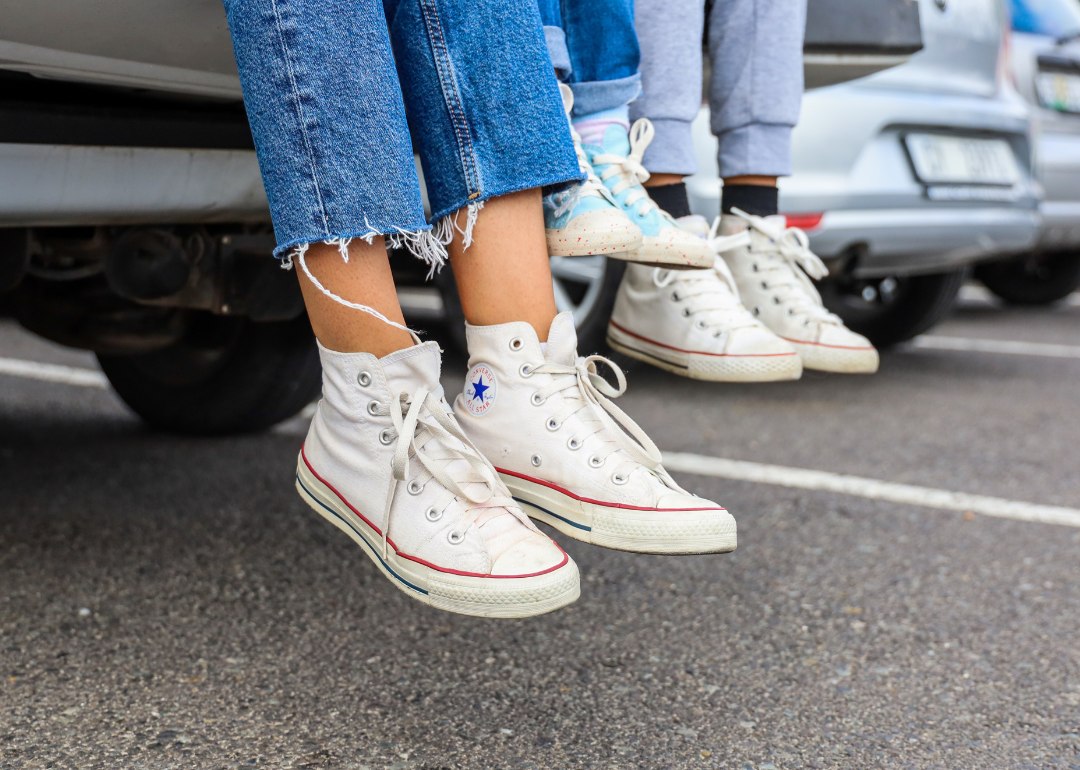
Some slang phrases start in one city or state, then spread out and are used all across the country. That's not the case for the Illinois slang word for tennis shoes or sneakers: . Allegedly only two cities in the country (Chicago and Cincinnati) use the phrase to describe their lace-ups.
Indiana: Hoosier
Hoosier is a word used to describe an Indiana resident. More specifically, a Hoosier is someone who lives and breathes Indiana, and is wholeheartedly in love with the state. While the origins of the word are a little murky, it has been widely used since .
Iowa: Padiddle
In Iowa, used for a car with only one working headlight. The phrase is often used in a "punch buggy" type game, where players who spot a padiddle attempt to yell out the word first, then get to pinch or kiss their opponent.
Kansas: Get loaded
Have one too many at your local bar on a Friday night, and your fellow Kansas natives will let you know that you've "." The slang phrase for inebriation is more popular with the younger crowd, as is most slang, but even older generations will sometimes use this turn of phrase when describing their indulgences.
Kentucky: Kentucky waterfall
As is the case with most flyover states, Kentucky has its share of unfair stigmas鈥攍ike a prevalence of rednecks. Locals here have responded to those stereotypes by co-opting them and using them for slang. For example, a is a mullet, a popular haircut in the state.
Louisiana: Sha
Louisiana is a state with so much local slang that many visitors feel as if residents are speaking an entirely different language. . Derived from the French word "cher," the Cajun and Creole slang word is used to describe something sweet or cute, like a baby, or to call someone a sweetheart.
Maine: Ayuh
" is not a noise one might utter when lifting something incredibly heavy. Instead, it means "yes," or is a form of acknowledgment, in the northernmost state.
Maryland: Sice
Excited about something in Maryland? . Sice can be used to describe excitement or to acknowledge that something is being exaggerated.
Massachusetts: Wicked
of local slang, wicked doesn't mean bad or evil in Massachusetts. Synonymous with "very," wicked can be used to describe almost anything: wicked cold, wicked fast, wicked delicious.
Michigan: Ope!
More a noise than a full-blown definable word, " as a reaction to anything slightly inconvenient or bothersome. Someone bumps into you? Ope can be used as both an exclamation and an apology. Dropped something? Ope is a perfectly acceptable expression of annoyance.
Minnesota: Uffda!
Another thing that's common in Midwestern states is . Uffda is a prime example of that. Used to communicate exhaustion, frustration, surprise, confusion, or repulsion, the word has Scandinavian influences and rolls off the tongue quite easily.
Mississippi: Fixin'
Judging by the rate at which you hear you might assume that nearly everything in the state is broken, but you'd be mistaken. Fixin' is used here, and in other regions in the South, to mean that you're getting ready to do something. For example, "I'm fixin' to go to the store."
Missouri: Put out
In Missouri, if you're , you're likely angry or at least pretty ticked off. What might be so upsetting? Maybe a Hoosier, which, unlike in Indiana, is another way of saying redneck.
Montana: Cowboy up
Many Americans still think of Montana as the Wild West. And to some degree, they're not wrong鈥攍arge parts of Montana are still wild and open. One of their most commonly used slang phrases, , means to get it together and handle whatever's in front of you.
Nebraska: Hay-waddy
Nebraska has one of the largest concentrations of farmland in the country. As such, most people in the state are involved in farming. is a popular slang term used to describe a worker who's temporarily employed in haying, or mowing dry grass and baling it for animal feed.
Nevada: Toke
In most parts of the country, the word toke has to do with drug use; not so in Nevada. Here it means you give a casino dealer. Just be careful how you use this one outside of Las Vegas.
New Hampshire: Hornpout
In New Hampshire, if you while fishing, you don't have a load of trash on your line like you may assume. Hornpout is the local name for catfish, native to the region and a prize catch for local fisherman.
New Jersey: Jug handle
The highways and byways in New Jersey have a unique set-up. Drivers looking to make left-hand turns are often forced off the road by a , a small road that exits to the right and is curved like a jug's handle, before they can complete their turn. It's an awkward and often frustrating set-up that residents complain does little to help the flow of traffic.
New Mexico: Christmas
No, it's not the holiday season year-round in New Mexico. If someone asks you if you want Christmas, they mean with your meal. The correct answer, according to natives, is an emphatic yes.
New York: Schvitzing
New Yorkers have a whole host of local slang words at their disposal, most of them . For example, schvitzing is Yiddish-turned-NYC slang for sweating, something New Yorkers do all hot and humid summer long.
North Carolina: Yonder
Another , yonder is used in North Carolina to describe a location that's far, far away. While it's far from precise, it has become ubiquitous in the state's vocabulary.
North Dakota: Hotdish
Known in other parts of the country as a casserole, hotdish is the preferred slang word in North Dakota. made its first appearance in the 1930s, and has been going strong ever since.
Ohio: Sweeper
Growing up, any Ohio kid knows that if they're asked to pull out for the living room floor, they're being asked to grab the vacuum. Anywhere else in the country, a sweeper is just another word for a broom.
Oklahoma: Quakenado
A more recent addition, quakenado was only added to the Oklahoma lexicon in 2011. when an earthquake and tornado take place at the same time, which happened in November 2011. Today, it's often used as a badge of honor for those who lived through the event.
Oregon: Spendy
This bit of Oregon slang is pretty easy to suss out: the same thing as pricey or expensive. It has caused its fair share of confusion among out-of-towners, especially for those who don't believe it's really a word.
Pennsylvania: Jawn
If you've ever spent time in Philadelphia, or Pennsylvania in general, you've probably heard someone use the word . According to linguists, there's really no other English word like it. Since the 1980s, jawn (a spinoff of the New York word "joint") has essentially been an all-purpose noun, a whatchamacallit type word, that could refer to a place, thing, person, or group of people in a negative or positive way.
Rhode Island: Bubbler
Born in Kohler, Wisc., in 1888, the drinking fountain is now a staple of parks, schools, and gyms around the country. However, in Rhode Island, Perhaps because the water sort of bubbles out of the spout.
South Carolina: Cackalacky
A nickname for the Carolinas, cackalacky became popular in the mid-20th century. There's no clear point of origin for the word, but cackalacky has become increasingly popular over the last 50 years.
South Dakota: Pert'near
Pert'near has a couple of different meanings in South Dakota. A it can mean something close by, or used synonymously with "almost." A common way to use it: "We've got this pert'near finished."
Tennessee: Meat and three
Open a menu anywhere in Tennessee and you'll probably see listed. A typical Southern dinner, it's a plate of meat and three sides, with gravy and a biscuit, best washed down with sweet tea.
Texas: Piddle'o
Texas may be one of the biggest states in the union, but , piddle'o, actually means small. There's no clear place of origin for the word, but spend any time in Texas and you'll see it's a staple in the state's vernacular.
Utah: Sluff
Most of us have skipped school or called out of work at least once in our lives. In Utah, they call that sluffing. Fun to say and even more fun to do, uses for a slang word from all 50 states.
Vermont: Creemee
On a hot summer afternoon in Vermont, you may head down the road and cool off. Called soft serve in every other part of the country, Vermonters are particularly partial to maple creemees.
Virginia: Ji
On its own, ji sounds a little odd. However, when you hear in conversation, it's being used as a filler adjective, like "very" or "really."
Washington: Skookum
Much like pidgin, is not the official language of any one Native American tribe. Rather, it's a collection of words and phrases various tribes who spoke different languages used to speak to each other. Many Chinook words are still used in Washington, including skookum, which means strong or tough.
West Virginia: Biggidy
In West Virginia, if you're , then you're acting too big for your britches, or full of yourself. Similarly, acting briggity means acting like a show-off. It seems that folks here have no problem calling you out for coming off as self-absorbed.
Wisconsin: Recombobulation
Recombobulation may sound like , but in Wisconsin, it means the opposite of discombobulation. The concept is so prevalent, all three terminals in the General Mitchell International Airport have "Recombobulation Areas" after security, where travelers can put their shoes back on, get their bags back in order, and move forward with their journeys.
Wyoming: Silk
Cattle country through and through, much of is centered around cowboys, farming, and ranch life. For example, silk doesn't refer to a glossy, lustrous piece of fabric, but rather the barbed wire used to keep animals inside their enclosures. Biscuit doesn't refer to the Southern food side dish, but a saddle horn.