The leadership agenda always tells the truth
Open a leadership team’s agenda and you’ll see more than topics. You’ll see how they think.
Too often, agendas read like extended to-do lists: chasing operational issues, signing off on decisions managers could handle, or circling around the same problem for months. If the list is long, tactical, and cluttered with fixes, it’s not just bad meeting hygiene. It’s a symptom.
The real issue is mindset.
The Mindset Trap
Leaders are rewarded for solving problems. It’s instinctive. See a fire, put it out. Someone hesitates, step in. In most cultures, this is what leaders are praised for—quick answers, visible decisions, heroic rescues.
But in complexity, that instinct backfires. When senior leaders rush to fix, they keep decisions at the top. They slow the system instead of enabling it.
As Harvard’s Richard Hackman put it in : “A leadership team adds value only when it does what no other group can.” If the agenda is filled with items that could be handled elsewhere, the team isn’t leading. It’s managing with fancier titles.
And when leadership meetings become battlegrounds of functional representatives defending turf, the agenda becomes a catalogue of disputes rather than a roadmap for the future.
What Leadership Teams Should Do
A leadership team’s role is not to do more, but to create the conditions for others to do more themselves.
That means anticipating what complexity will throw at the system and making strategic choices about design before the problems hit their desks. It’s not about fixing broken pipes every week—it’s about redesigning the plumbing so it doesn’t burst in the first place.
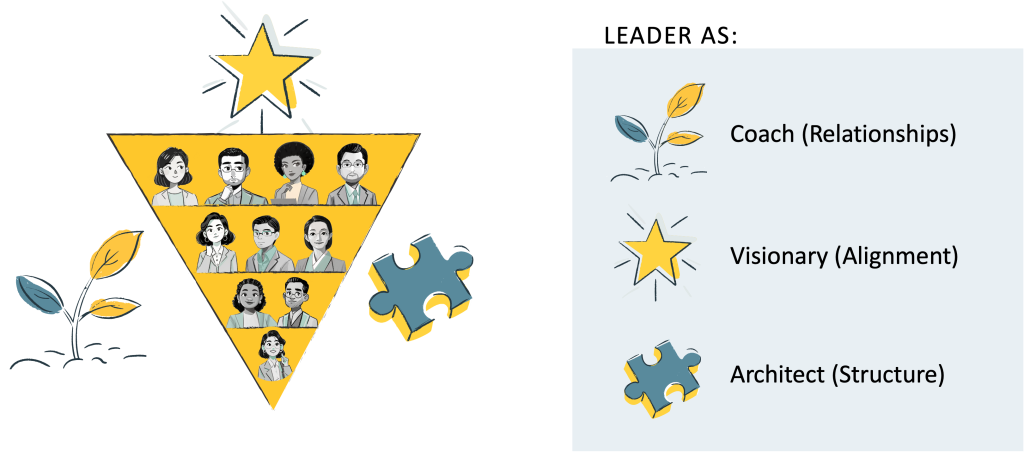
The shift requires working at a different altitude:
- Architects – Designing the system. They clarify roles, processes, and decision rights so decisions don’t clog at the top. They anticipate where bottlenecks will occur and fix the design, not the symptom.
- Coaches – Building the human fabric. They focus on trust, relationships, and psychological safety. They model collaboration instead of turf wars, knowing that in complex environments, strong relationships are the only shortcut that works.
- Visionaries – Framing the bigger picture. They connect daily choices to customer demands, context, and purpose. Complexity requires constant reorientation—people need to know why priorities shift, not just what to do today.
When leadership teams play these roles, the agenda changes. It becomes shorter, sharper, more anticipatory. It stops being a list of problems and becomes a platform for system-level design.
Lessons From Toyota
Consider Toyota. In their factories, frontline workers are empowered to stop the whole production line when they see a defect. That’s an enormous amount of delegated authority. Why does it work?
Because the leadership team has already set the conditions: quality is the non-negotiable context. Everyone understands it, so frontline employees are trusted to act on it. Leadership doesn’t need to be in the room for those decisions, because they’ve architected a system, coached a culture, and reinforced a vision that makes it safe to act.
The same is true of quality circles—small groups empowered to solve problems continuously. The leadership team doesn’t spend its agenda debating defects. Instead, it focuses on the conditions—structure, trust, and purpose—that allow the system to respond to complexity at speed.
What a Healthy Leadership Team Agenda Looks Like
- Fewer items. A page, not a long list.
- System-level questions. Instead of “Should we approve the new printer lease?”or “How do we clarify what decisions stop at this table?”
- Balance. Attention spread across structure, relationships, and vision.
- Forward-looking. Anticipating the next curve in complexity rather than mopping up yesterday’s mess.
As one team coach observed after years of sitting in these rooms: “The agenda always tells the truth. It shows whether a team is really leading, or reacting.”
Try This
Review your last leadership team meeting agenda:
- How many items were tactical, requiring fixes and decisions from you?
- How much time was spent on creating conditions—structures, roles, or decision rights?
- And the critical question: With the right conditions in place, which of these items could have been delegated?
If the balance tilts heavily toward firefighting, that’s your culture speaking. The agenda is the symptom, but the root cause is mindset.
Ask yourself: If your leadership team disappeared tomorrow, what would stop happening? If the answer is approving expense items or solving last month’s conflicts, you’re not leading yet.
Bottom Line
The effectiveness of a leadership team isn’t measured by how much it does. It’s measured by how well it creates the conditions for everyone else to do.
That’s the mark of a developmental organization—the leadership team at the bottom of the pyramid, supporting the rest. Flip the agenda, flip the mindset, and you flip the organization.
was produced by and reviewed and distributed by Â鶹ԭ´´.