Earth Day to school strikes: A timeline of the American environmental movement
Earth Day to school strikes: A timeline of the American environmental movement
It's impossible to pinpoint the exact start of American environmentalism, but the movement grew its roots in the writings of 19th-century naturalists. Since then, the grassroots campaign has grown to the political and often radical actions of today, such as the 2019 Global Climate Strike.
Some date the modern environmental movement back to in 1962. Others cite the as a major influence. Many, however, , with the first celebration of Earth Day. Regardless, the movement has grown and transformed in the past several decades; Earth Day, for example, started in the U.S. with millions of people and has grown to a with over 1 billion participants each year.
The movement has also become more political since its early days. In the 1970s, environmentalism focused on fixing pollution, and support for such actions was generally bipartisan. Now, Republicans and Democrats clash on core issues like climate change, and protesters have even sued the government for their alleged knowing role in contributing to it.
Activists have adopted numerous strategies to address environmental issues like pollution, logging, oil drilling, and climate change. Today, protesters with actions like sit-ins and school strikes. Advocating for legislation is also a major component of the movement, as it always has been. Naturalists and scientists educate the public by publishing scientific research and writing books. People of color have also created an environmental justice movement that combines concern for the environment with racial and economic justice.
compiled a timeline of 30 crucial moments in the American environmental movement from news, academic, and government reports. Read on to discover the influences of environmentalism in the U.S. and how activists are driving forward these efforts today.
[Pictured: Earth Day, New York City, 1970s.]
August 1854: Henry David Thoreau publishes 'Walden'
After living in a cabin in the woods for two years, naturalist Henry David Thoreau published 鈥淲alden,鈥� a book reflecting on his experiences in nature. Though he died in 1862, before the American environmental movement began, environmentalists have since about .
[Pictured: Walden Pond, Concord, Massachusetts.]
March 1872: Yellowstone becomes the first U.S. national park
Saving Yellowstone from , President Ulysses S. Grant signed the Yellowstone National Park Protection Act into law on March 1, 1872, making it the 鈥攏ot just in the U.S., but in the world. Spanning almost 3,500 miles of geysers and rivers and mountains in Wyoming, Yellowstone started a national tradition of .
[Pictured: Heart Spring, Yellowstone National Park, Wyoming.]
May 1892: John Muir co-founds the Sierra Club
John Muir, , established the Sierra Club on May 28, 1892. He was elected as its first president and served until his death in 1914. The Sierra Club continues to fight for the protection of the environment, such as by .
[Pictured: Theodore Roosevelt and John Muir in Yosemite National Park, c. 1906.]
May 1900: Lacey Act protects wildlife
The Lacey Act was the . The law originally helped states protect native animals hunted as game. It has since expanded to outlaw the international transport or trade of illegally caught or possessed animals and plants, cutting down on, for example, the .
[Pictured: Illegal rosewood stockpiles in Antalaha, Madagascar.]
August 1916: Woodrow Wilson forms the National Park Service
On Aug. 15, 1916, President Woodrow Wilson to unify and oversee the rapidly expanding U.S. National Park System. The park service is in charge of conserving these public lands to allow for future enjoyment. It now protects over 84 million acres in all 50 states.
[Pictured: Capitol Reef National Park, Utah]
July 1918: Migratory Bird Treaty Act protects native birds
In the 1800s, with little to no regulations in place, hunters killed many U.S. birds and . Congress passed the Migratory Bird Species Act of 1918 to protect nearly all native U.S. birds, including their nests and eggs. However, the Trump Administration plans to revise the Act so that , a move environmentalists say would .
[Pictured: Northern Pintails in flight, Bear River Migratory Bird Refuge, Utah.]
April 1933: The Civilian Conservation Corps is born
Just a month into his presidency, President Franklin D. Roosevelt created the Civilian Conservation Corps as part of his New Deal to spur recovery from the Great Depression. The corps employed three million men over nine years to plant millions of trees, remove invasive plants, and fight tree-killing insects. The New Deal is one source of inspiration for the .
[Pictured: Civilian Conservation Corps men using Pulaski axes.]
July 1955: Air Pollution Control Act is passed
Air pollution caught public attention in the 1940s when stung people鈥檚 eyes and . After years of federal resistance to air pollution legislation, President Dwight Eisenhower signed the Air Pollution Control Act of 1955, which was the . It provided funds for research and paved the way for later air pollution control legislation.
[Pictured: Los Angeles, California, 1940s.]
September 1962: Rachel Carson publishes 'Silent Spring'
Despite the challenges of being a woman scientist and writer in the 20th century, marine biologist Rachel Carson published the landmark book 鈥淪ilent Spring鈥� in 1962. The book detailed the harm reap on the environment for a popular audience. Carson鈥檚 work in 1972 and chemists to .
[Pictured: Rachel Carson.]
February 1968: Workers start Memphis Sanitation Strike
On Feb. 11, 1968, 1,300 sanitation workers . The strike was one of the founding acts of the , in which people of color began demanding attention to the disproportionate amount of pollution they faced.
[Pictured: Sanitation Workers Strike, Memphis, Tennessee, 1968.]
December 1968: NASA Astronaut snaps iconic 'Earthrise' photograph
NASA astronaut William Anders took the by a human from deep space. The Apollo 8 image showed how unique, alone, and difficult-to-replace the Earth is. The environmental movement used this image as an icon, and .
[Pictured: Photo of Earth taken from space, 1968.]
January 1969: Santa Barbara Oil Spill captures the world鈥檚 attention
The Santa Barbara Oil Spill onto California coast, killing . The worst oil spill at that point in time; it drew global attention and prompted people to consider humans鈥� . In the following years, state and federal powers placed a off of California.
[Pictured: Oil spill in Santa Barbara, California, 1968.]
June 1969: Ohio鈥檚 Cuyahoga River catches fire
Just months after the Santa Barbara Oil Spill of 1969, Ohio鈥檚 Cuyahoga River caught fire. In fact, the river was and had caught fire at least nine times before. But on June 22, 1969, the fire caught the world鈥檚 attention and became a symbol of the American environmental movement.
[Pictured: Firemen stand on a bridge over the Cuyahoga River to spray water on the tugboat Arizona in 1952.]
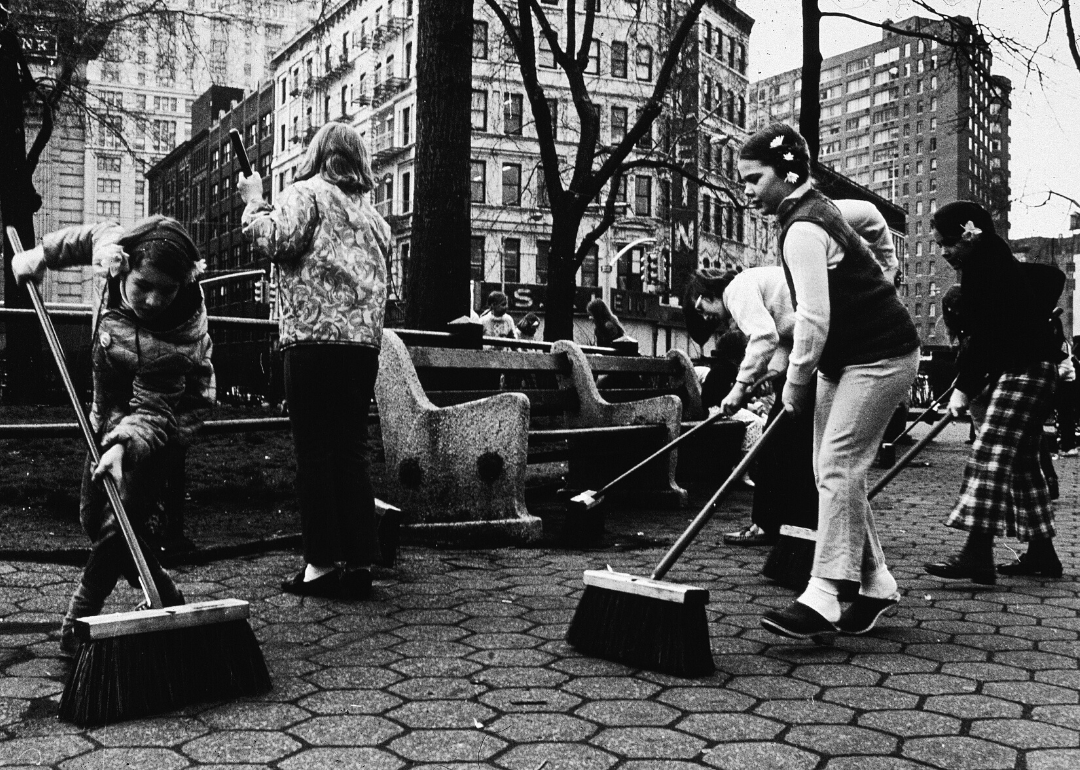
April 1970: Activists celebrate the first Earth Day
On April 22, 1970, 20 million people celebrated the first Earth Day. The event forced the issue of the environment, previously absent from most media and political discussions, into the national agenda. The gathering provided the and eventually led to legislation like the Clean Water Act.
[Pictured: Children use push brooms to sweep a city park during Earth Day, New York City, 1970s.]
December 1970: President Nixon establishes the Environmental Protection Agency
In the early 1970s, as a response to recent landmarks in the early environmental movement, President Richard Nixon . On Dec. 2, with , he created the Environmental Protection Agency to consolidate many federal environmental actions. However, President Donald Trump's proposed budget for fiscal 2021 would .
[Pictured: The EPA flag.]
August 1971: Dr. Seuss publishes 'The Lorax'
Children鈥檚 book author and illustrator Dr. Seuss鈥檚 鈥淭he Lorax鈥� . The book was Seuss鈥檚 , and a school district in California . 鈥淭he Lorax鈥� has continued to be iconic in the environmental movement and was adapted into a movie in 2012.
[Pictured: "The Lorax" by Dr. Seuss.]
October 1972: Clean Water Act is passed
The Federal Water Pollution Control Act, known commonly as the Clean Water Act, is the major federal legislation maintaining water quality and . Its creation was influenced by the inaugural Earth Day in 1970, and it was the .
[Pictured: Hudson River, New York.]
December 1973: Endangered Species Act protects threatened species
In 1973, 80 nations met in Washington D.C. to sign a . To protect animals and plants at home, the U.S. government created the , the foundational conservation law protecting plants and animals in the U.S. from extinction.
[Pictured: Siberian tigers.]
April 1987: United Church of Christ publishes toxic waste study
The United Church of Christ鈥檚 Commission for Racial Justice published a crucial report for the environmental justice movement called 鈥淭oxic Waste and Race.鈥� It was the first study to investigate the at the national level. The research found that the is the best predictor of whether there is a toxic waste site in a neighborhood.
[Pictured: Toxic waste barrel.]
June 1990: Indigenous Environmental Network is formed
The Indigenous Environmental Network, now consisting of indigenous people from around the world, was founded in the U.S. in 1990. The goal of the network is to build the capacity for indigenous communities to .
[Pictured: Forward On Climate Rally in Washington DC.]
October 1991: First People of Color Environmental Leadership Summit
From Oct. 24 to 27, 300 people of color, including international participants and people , met in Washington D.C. to draft and adopt 17 principles of environmental justice. The principles not only address the destruction of the environment but also colonization and oppression. The principles have been considered a .
[Pictured: Steps of the Capitol building.]
November 1998: U.S. signs the Kyoto Protocol
On Dec. 11, 1997, over 150 countries signed the Kyoto Protocol, an international agreement to lower greenhouse gas emissions to below 1990 levels. The on Nov. 12, 1998, but later . The success of the protocol has been limited, in part because international powers like the U.S. refused to ratify it.
[Pictured: Power plant, Apollo Beach, Florida.]
April 2010: Environmentalists protest BP after Deepwater Horizon oil spill
When BP鈥檚 Deepwater Horizon oil platform exploded in waters offshore Louisiana, it caused the . Having suffered long-lasting damage, nearby ecosystems . In the oil spill's aftermath, over 300,000 people joined a Facebook group .
[Pictured: Fire engulfing off shore oil rig Deepwater Horizon in the Gulf of Mexico near New Orleans, Louisiana.]
April 2014: Activists protest Flint Water Crisis
On April 25, 2014, officials in Flint, Michigan , which was contaminated with lead from old pipes. Even before research proved that the water was unsafe, because their tap water looked, smelled, and tasted unusual. Community members eventually sued the state and filed an emergency motion, and they eventually obtained door-to-door water bottle delivery.
[Pictured: National March In Flint To End Water Crisis, Flint, Michigan.]
September 2015: Youth file climate change lawsuit against federal government
From across the U.S., 21 youth filed a lawsuit against the federal government in 2015 for its . The case, Juliana v. United States, was in 2020. Counsel for the youth plaintiffs hasn't given up, however, and in 2021, asked the district court for .
[Pictured: Plaintiff Kelsey Juliana.]
September 2016: President Obama formally joins Paris Agreement
On Sept. 3, 2016, President Obama officially signed the United States into the Paris Agreement on the same day as China. The most ambitious agreement to , its goal is to limit warming in this century to two degrees Celsius. The in November 2020, the only nation to do so.
[Pictured: Barack Obama, Hangzhou, China.]
February 2017: Standing Rock activists protest Dakota Access Pipeline
The Dakota Access pipeline, running , was slated to cross the Missouri River . The tribe responsible for the pipeline on Aug. 4, 2016. at Standing Rock for months, even when faced with freezing temperatures and violence from law enforcement. , but there have been ongoing efforts to .
[Pictured: Dakota Access Pipeline Protest, Standing Rock, North Dakota.]
April 2017: Sunrise Movement is launched
The , led by young people in their 20s, uses Civil Rights-era protest techniques to and push for the Green New Deal. The group includes more than 80,000 activists that have participated in indirect action, like sending emails and 15,000 who have engaged in direct action like sit-ins and school strikes.
[Pictured: Chicago Sunrise Movement, Chicago, Illinois.]
February 2019: Representative Ocasio-Cortez introduces Green New Deal
The Green New Deal was and has since gone through many iterations. Representative Alexandria Ocasio-Cortez on Feb. 7, 2019. The goal of the proposal is to reduce greenhouse gas emissions to while simultaneously addressing racial and economic injustice.
[Pictured: Representative Alexandria Ocasio-Cortez in Washington D.C.]
September 2019: Youth activists lead Global Climate Strike
Internationally, four million people on Sept. 20, 2019. Greta Thunberg, a 16-year-old Swedish climate activist who ignited the school climate strike movement, , where up to 250,000 people demonstrated. Youth from all over the continued to strike on Fridays as part of the Fridays for Future campaign, which Thunberg inspired. .
[Pictured: Greta Thunberg at the 2020 Fridays For Future Climate Demonstration, Hamburg, Germany.]