This story originally appeared on Rocket Solar and was produced and distributed in partnership with 麻豆原创 Studio.
How the cost of solar panels has fallen
The energy the earth absorbs from the sun in just hour is for a year. Why, then, is the world not taking greater advantage of this renewable energy source?
Despite the detrimental environmental effects, fossil fuel infrastructure is well-established and . On top of that, humans have only recently managed to harness the sun's energy in a way that is also efficient, scalable, and relatively affordable. About like oil, coal, and natural gas.
Solar energy capacity in the United States is made up of large- and small-scale systems. Solar energy at utility scale鈥攍arge facilities that generate at least 1 megawatt of power for the grid鈥攔epresents the in the U.S. The second largest market is residential, followed by commercial and community.
cited data from the to look at how the cost of solar panels has fallen and what that means for electric power in the U.S.
At one time, solar-generated electricity was cost-prohibitive; however, it became increasingly attainable as its price decreased by about 90% . One of the main reasons the costs have fallen so dramatically is that the photovoltaic solar panels . Similarly, as efforts to increase solar energy production have grown, the cost of necessary components has decreased. Private and government-funded research and development also played a key role in reducing solar costs.
Keep reading to discover how the cost of solar panels has fallen.
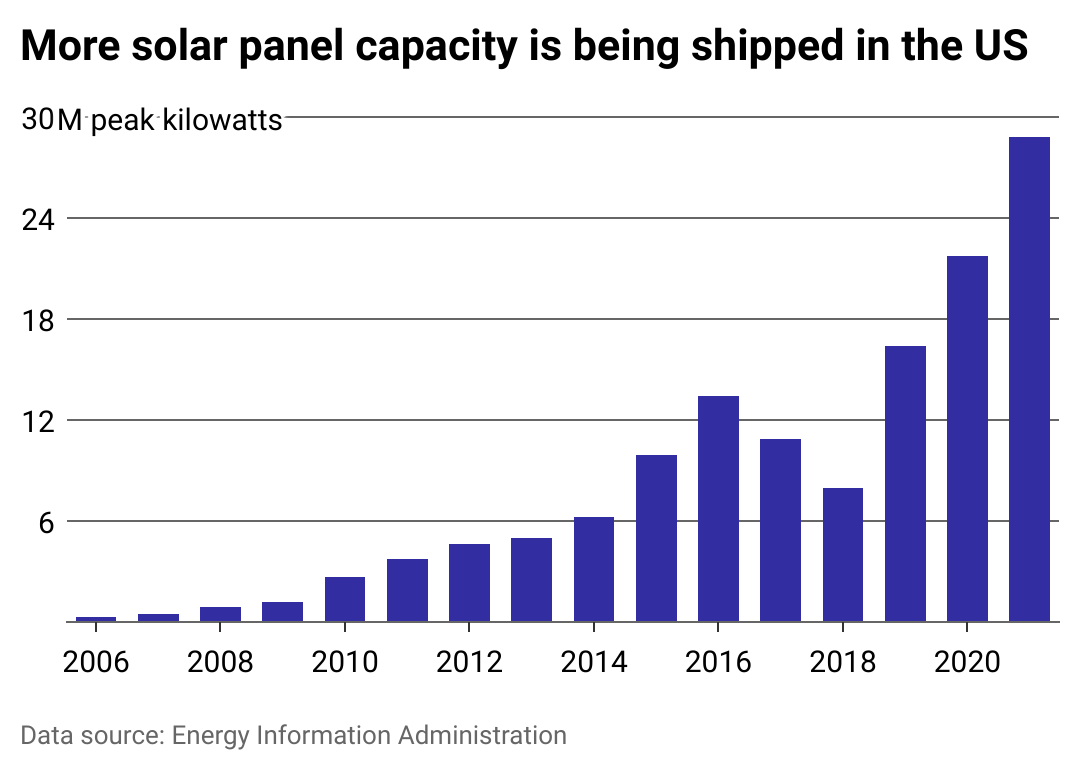
Solar panel shipments have grown significantly in the last 15 years
Solar panels shipped to the U.S., measured in electricity-generating capacity, rose to a record 28.8 million peak kilowatts in 2021, according to the EIA. This unprecedented high was achieved despite supply chain constraints and higher-than-usual material costs over the last several years.
About shipped in the U.S. were imported from Asia. California, Texas, Florida, Georgia, and Illinois accounted for roughly half of all received shipments in 2021. Utility-scale and residential solar installations have grown substantially year over year, , respectively.
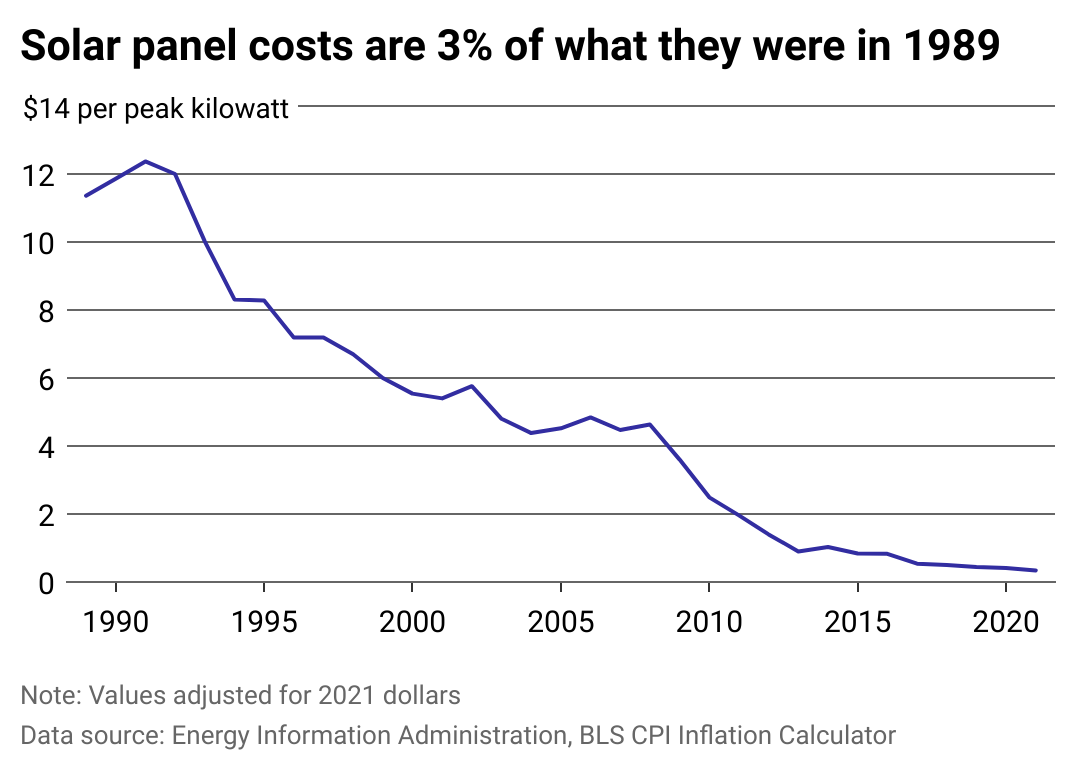
Lower prices have followed that growth
Today, solar panels are 94% cheaper than they were in 1989. As the production and energy-generating capacity of solar panels has improved over the last few decades, the cost has dropped significantly.
This is a quintessential example of economies of scale in manufacturing. Dating back even further to the mid-1970s, every time the global cumulative capacity of photovoltaic cells doubled, prices saw the same relative decline, according to cost and capacity data .
Over the last several years, construction costs for renewable energy have increased in line with , rising raw material costs, supply chain and shipping constraints, and . This has made new solar construction more expensive than other forms of renewable energy at a utility scale, despite dramatic cost reductions.
Falling prices made solar a competitive electricity source with fossil fuels
The efficiency and affordability of solar, combined with the skyrocketing costs of fossil fuels, have made solar a competitive electricity source on a large and small scale.
Roughly 50 years ago, solar technology was so expensive that it could . Over the next 20 years, costs fell dramatically. In 1976, solar panels cost and had a capacity of 0.3 megawatts鈥攅nough to provide electricity for only 20 people annually鈥攚hich was highly impractical.
Today, they cost less than 50 cents per watt with a capacity of more than 100,000 megawatts. While solar energy has become more affordable, global events over the last several years have created huge volatility in the crude oil market, driving up the cost of energy derived from fossil fuels.