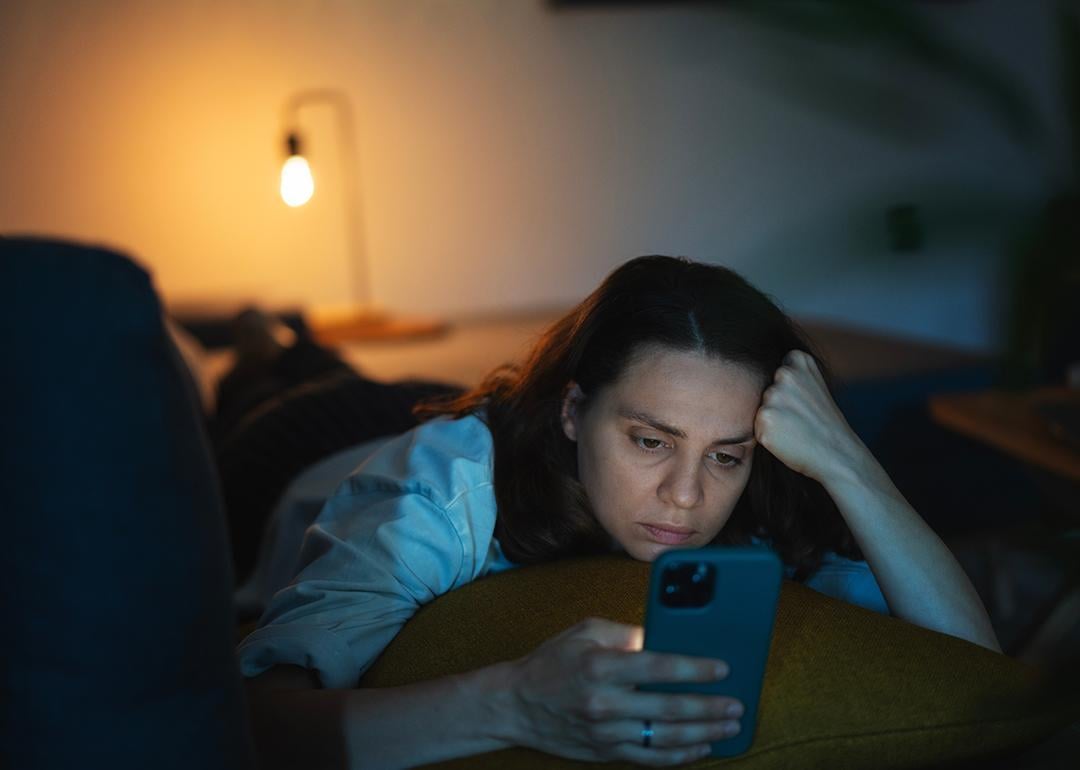
What's really driving your late night screen addiction?
What's really driving your late night screen addiction?
Many of us know the feeling: It’s late, you’re exhausted, and yet you find yourself scrolling endlessly on your phone. What starts as a quick check-in can easily spiral into hours of lost time and contribute to sleep deprivation. Using your phone late at night is tempting, but at a certain point, it can impact your health, relationships, and overall wellbeing, reports .
a licensed creative arts therapist, shares how creative tools can help you break these patterns and find healthier ways to cope. Read on to learn about what screen addiction can look like, why it’s so hard to put the phone down at night, plus a simple art exercise you can use tonight to start cutting back on bedtime scrolling.
Could your late night screen habit be an addiction?
Here are four signs that your phone scrolling may indicate signs of addiction that you may want to talk to a therapist about:
- Lack of control. You may feel powerless over your behaviors.
- Noticing that it’s impacting your relationships or responsibilities.
- You feel it’s consuming your inner world.
- It’s become your go-to coping strategy or way to avoid difficult thoughts and feelings.
What can drive screen addiction?
There are a few things that can drive screen addiction. The first one is low self-esteem and seeking validation.
If you post something and you allow that vulnerability to leave your body, and it’s out there in the ether, you might want to get “love” in response to it in the form of hearts and comments. Those hearts or those comments can mean something for sure. And they can keep us connected. So it works at some level, but in terms of a deeper interpersonal connection, it might not make the cut. It might not be quite as meaningful as catching up with people in other ways.
If those hearts or those comments don’t roll in, it might leave you feeling a little bit empty inside. It doesn’t “fill you up” or sustain you the way more in-depth relationships do.
When we do something that is a behavior that keeps us wanting more, that is usually indicative of an addiction. Sometimes there’s an underlying trauma—my needs weren’t met and I can find solace in this thing, even if it’s temporary.
What is the cost of late night screen addiction?
One question that’s important to ask is “What’s the cost?” It’s a really good deepening question that can help reframe the situation and develop a little more insight into your own behaviors.
Ask yourself: Okay, I’m going to keep scrolling, but what’s the cost? What is it giving me? What is it not giving me?
When you think of the cost of spending that time late at night in bed on your phone, think of things like quality of sleep and amount of sleep, as well as other things you could be doing. Possibly something to prepare for the next day, even if it’s as small as washing a couple of dishes. One way to look at it: A tonight problem doesn’t have to be a tomorrow problem, but we have to take action. We have to do the thing, right?
So if you’re getting sucked into the void, congratulations, your tonight problem will also be a tomorrow problem. Now, that needs to be handled with care because there can be a lot of underlying reasons why we can’t take action. But just considering “What am I losing due to this habit?” can be meaningful.
Why are we so susceptible to endless scrolling at night?
For starters, we’re finally unbound by stressors and the chains keeping us in the rhythm of our day. We don’t have anybody watching over our shoulder. We feel that sense of freedom and that sense of autonomy. Like we can finally do whatever I want to do!
At the same time, it’s a bottomless pit.
So it can help to think, “Okay, maybe I could put a time limit on this.” Or maybe, “I’m just gonna do one task or just look at one app for this amount of time,” and then try to put a little bit of structure around it. At the very least, you can create some sense of containment around it so that you’re not just going and going and going.
If you’re unable to create that containment, that’s a good sign to talk to a therapist about this issue.
Can therapy help with screen addiction?
Yes, therapy can help with screen addiction. For example, with clinical art therapy, we can make the unconscious a little bit more conscious by using the creative process to express our thoughts and feelings.
And by doing that, we gain insight into ourselves, our emotions, our patterns, maybe even our traumas. And it can help us gain a certain level of awareness and maybe even a sense of understanding about ourselves.
Art therapy allows you to be creative and maybe even have a little fun, but also do great things for your neural networks by visiting this topic creatively and weaving a new narrative.
How and why does art therapy work?
Art therapy can be a less intimidating or threatening way of diving deeper into your thoughts. Everybody’s different. The therapist will get to know their client and work with them and meet them where they’re at. So wherever you fall on the artistic spectrum, creative arts therapists are able to meet you and help you gain some insight.
Art therapy can help make the unconscious a little bit more conscious because it uses lines, shapes and colors to express what that inner feeling is — it gives it some body. It gives it some tactile or observable feeling. If you’re using clay, it’s literally tactile in your hands. If you’re using two-dimensional media, you can still see it.
Using any sort of expressive medium gives you something to contain those feelings and something to bring them out in a different way.
You don’t need to go into the art making necessarily knowing exactly what you’re making and why, you can just be in the moment and embody it. Ask yourself, “Am I putting more pressure? Am I kind of going light? Am I trepidatious?” All of these things are the body’s way of communicating what it needs to get out.
Be sure to save time at the end to verbally process that and connect those dots of “Hmm, why did I feel really anxious when I was drawing the wings on my creature?” It could be anything. This gives your body a chance to express what it needs to, but then also to move to that other, more cognitive side of processing it as well.
Is it possible to replace a late night screen habit with an art habit?
You don’t have to be an artist or have any previous experience to use art as a helpful way to address the urge to scroll on your phone.
Consider keeping a notebook or sketchbook right next to your bed or on your desk, or wherever your phone typically is. Keep that notebook and try to grab that instead of your phone. It might feel really uncomfortable at first—in art therapy, this is the tension or discomfort you feel in your body. But maybe that short term discomfort of not getting the instant gratification of your phone could be worth it because, by reaching for the art supplies, you get a chance to express yourself and regulate your emotions.
You might even reach a flow state that could be really healing. It’s a way to think of slowly, gently challenging and maybe even replacing certain behaviors. And over time, maybe you’re not even thinking about the phone so much.
was produced by and reviewed and distributed by Â鶹ԭ´´.