Women who broke barriers throughout military history
Women who broke barriers throughout US military history
The U.S. military's demographics over the years have become increasingly representative of the American population. Yet gender demographics in the armed services continue to be unequal, with women today as of 2020. That statistic is largely due to centuries of laws and regulations that kept women from performing many roles and duties. Consider that women couldn't fly in combat missions until 1991, didn't have access to all combat roles until 2015, and that the did so in 2016. Despite these obstacles, American women have pushed to find ways (at times, creatively) to serve their country since the Revolutionary War.
To showcase their patriotism and sacrifice, 麻豆原创 compiled a list of 30 women who broke barriers throughout U.S. military history based on historical sources, news outlets, and various branches' press releases. The achievements of these women span all branches of the military鈥攆rom land to air to sea鈥攁nd more than two centuries. Many of these breakthroughs, moreover, transcended military service: Several women earned historic promotions in rank, and thus noteworthy leadership roles supervising cadets or commanding troops; others won nationally renowned distinction such as the Purple Heart and Silver Star for their combat bravery, valor, and performance.
The list is in chronological order, starting with an 18th-century hero and ending with women setting records in the present day. From women who pretended to be men so they could serve during the Revolutionary and Civil Wars to the first female four-star general in the U.S., here are 30 women who broke through the glass ceiling of the U.S. military.
1782: Deborah Sampson
Deborah Sampson was one of several documented women who fought in the Revolutionary War. Sampson disguised herself as a man and joined the 4th Massachusetts Regiment as Robert Shirtliff. She closely guarded her secret, even removing a pistol ball from her own thigh to avoid detection by medics. Her during an epidemic more than a year into her service and received medical care. Later, the Massachusetts legislature granted Sampson a pension, stating she had 鈥�.鈥�
1856: Sarah Emma Edmonds
Under the male alias of , Sarah Emma Edmonds served during the Civil War. Thompson was born in Canada but moved to the U.S. in 1856 to escape a forced marriage and abusive father. Stateside, she enlisted as a male field nurse in the Union Army. She also reportedly worked as a spy who successfully infiltrated the Confederate Army.
1865: Mary Edwards Walker
Mary Edwards Walker became the first woman surgeon for the Union Army during the Civil War. She was captured in 1864 by Confederates and was held as a prisoner of war for four months. Upon her return, President Andrew Johnson awarded Walker with the Medal of Honor in 1865鈥攖he military鈥檚 highest distinction. To this day, Walker is the only woman to have ever received this medal.
1866: Cathay Williams
Cathay Williams was . Using the pseudonym William Cathay, she pretended to be a man and successfully served as a Buffalo Soldier until she revealed her true identity in 1868.
1917: Loretta Perfectus Walsh
Although women had worked as civilian nurses in the Navy during World War I, they were banned from other positions. That changed in 1917 when Loretta Perfectus Walsh became . She was sworn in just one month before the United States declared war on Germany. Newspapers around the U.S. covered the breaking news, which led to heightened enlistment numbers that helped bolster the military during the conclusion of World War I.
1918: Opha May Johnson
Opha May Johnson became in 1918. Little is known about her time in the corps, but historians do know she served with 300 other women during World War I. Their role? To resume office jobs at Marine Corps headquarters for men who would be shipping out to France. The patronizing nickname for these women鈥斺�淢arinettes鈥濃�攚as dropped by World War II as respect for their vital role grew.
1942: Lt. Annie G. Fox
In 1942, Lt. Annie G. Fox became the . Fox helped care for the wounded as chief nurse at Hickam Field during the attack on Pearl Harbor on Dec. 7, 1941. Fox was not injured, but nevertheless received the Purple Heart for her 鈥�.鈥�
1942: Dorothy Tuttle
Dorothy Tuttle was the , otherwise known as the Coast Guard Women鈥檚 Reserves. Women in this organization served the U.S. military by taking over office duties for men needed elsewhere during World War II.
1943: Lt. Elsie S. Ott
Lt. Elsie S. Ott was assigned as a flight nurse to bring five very ill patients from India to Washington D.C. during World War II in what was . At the time, Ott had never flown in an airplane and was without any evacuation training. Ott successfully brought home the patients, and in so doing earned the distinction of being the .
1948: Esther Blake
On July 8, 1948, Esther Blake became . The widowed mother of two sons (both serving), enlisted in the Women's Army Corps in 1944 to help end the war after her oldest son was shot down in service while flying a B-17 and reported missing. Her efforts only increased after that. Although women weren't allowed to fight, Blake enthusiastically took on office jobs in order to . Both of her sons were eventually found and returned home safely鈥攎eanwhile, Blake continued to serve in the Air Force until 1954.
You may also like:
1958: Ruby Bradley
Col. Ruby Bradley is one of the most decorated nurses in U.S. military history. Bradley was known as the 鈥�,鈥� a nickname she earned while caring for prisoners of war in the Philippines. She survived World War II and the Korean War, and in 1958 became the third woman in the U.S. to be promoted to colonel.
1972: Elizabeth Barrett
Cmdr. Elizabeth Barrett was the , overseeing hundreds of people during the time she served as the Commanding Officer of the Naval Advisory Group. Barrett鈥檚 tenure marks the .
1990: Darlene Iskra
Cmdr. Darlene Iskra paved the way for women from the beginning of her career in the Navy. She was one of the first women to , and later became the first woman to 鈥攖he USS Opportune鈥攊n 1990.
1991: Martha McSally
Lt. Col. Martha McSally is . She achieved this first in 1991 after Congress had struck down a law barring women from flying warplanes in combat. McSally has since moved into politics and was sworn into the Arizona Senate in 2019.
1993: Jeannie Marie Leavitt
Jeannie Marie Leavitt achieved . Throughout her career, she became the first female fighter pilot, the first to graduate from the Air Force Weapons School, and the first woman to command an Air Force combat fighter wing.
1999: Eileen Collins
Col. Eileen Collins became in 1999. Collins originally joined the before her selection for the astronaut program.
2000: Kathleen McGrath
No woman had ever until Capt. Kathleen McGrath took command of a 453-foot ship called USS Jarrett. Beginning in 2000, McGrath led her ship into the Persian Gulf to .
2004: Linda McTague
Col. Linda McTague does not view herself as a pioneer, even though many do. McTague is the first woman to command an Air National Guard wing and is believed to be the first woman in U.S. history to command an Air Force fighter squadron.
2005: Leigh Ann Hester
Sgt. Leigh Ann Hester in 2005 became the first woman since World War II to receive the Silver Star鈥攐ne of the most coveted awards given to members of the U.S. armed forces . Hester was awarded the medal after fighting off insurgents in Iraq during the war on terror.
2008: Ann Elizabeth Dunwoody
Gen. Ann Elizabeth Dunwoody is the first woman in U.S. military history to be promoted to four-star general. Gen. Dunwoody is known for her leadership skills and for her work preventing sexual assault in the U.S. Army.
2011: Sandra Stosz
In 2011, Vice Adm. Sandra Stosz became the first woman to when she was selected to be the superintendent of the U.S. Coast Guard Academy. A graduate of the U.S. Coast Guard Academy herself, Stosz later went on to serve as .
2012: Tammy Duckworth
Before she was elected to the U.S. Senate, Sen. Tammy Duckworth was an . During her time in Iraq, Duckworth鈥檚 helicopter was hit by an RPG, resulting in her losing both her legs. Upon her election to the U.S. House of Representatives in 2012, Duckworth became the .
2014: Michelle Howard
Naval Adm. Michelle Howard solidified her spot in the U.S. military record books for breaking barriers in many aspects of her career. A few of her accomplishments include becoming , the first female four-star admiral to command operational forces, and the first female graduate from the U.S. Naval Academy to be promoted to flag officer.
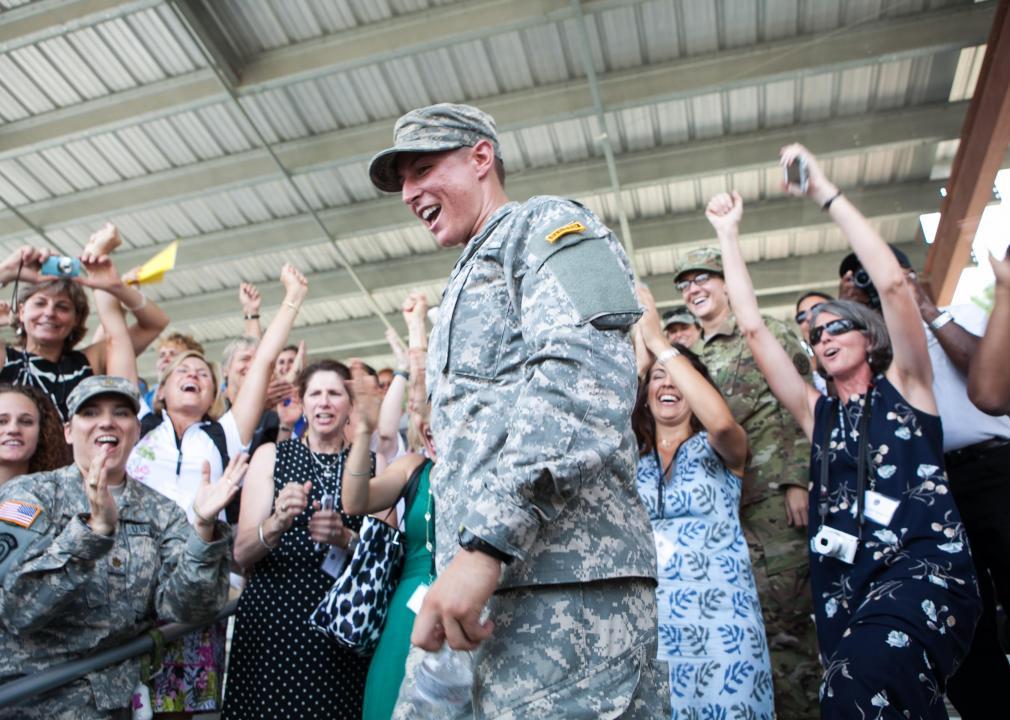
2015: Kristen Griest
Capt. Kristen Griest was one of the first women to graduate from the Army Ranger School and has since become . Women were barred from becoming infantry officers until 2015 when the defense secretary declared all combat roles were opened to women.
2015: Shaye Haver
First Lt. Shaye Haver alongside Capt. Kristen Griest in 2015. After this feat, Haver joined the infantry and .
2016: Kate Alfin
Army Capt. Kate Alfin completed the Allied Winter Course at the Norwegian School of Winter Warfare in 2016, becoming to do so. During the 26-day course, Alfin not only learned how to but also acquired mobility and leadership skills.
2016: Lori Robinson
Gen. Lori Robinson became the in 2016 when she assumed command of the North American Aerospace Defense Command and United States Northern Command. In an in 2017, Robinson reported that her two bosses were the president of the United States and the Canadian prime minister.
2016: Christy Wise
Despite losing her leg in 2015, Capt. Christy Wise did not lose her will to fight. Only a year after the injury and many hours of rehab later, Wise became to regain her wings.
2016: Dominique Saavedra
Chief Petty Officer Dominique Saavedra became . In 2016 she received and later served on a guided-missile submarine.
2017: Simone Askew
At only 20 years old, Simone Askew became . As first captain of the school鈥檚 4,400-member Corps of Cadets, Askew is tasked with planning class agendas and acting as the point of contact between cadets and school officials.