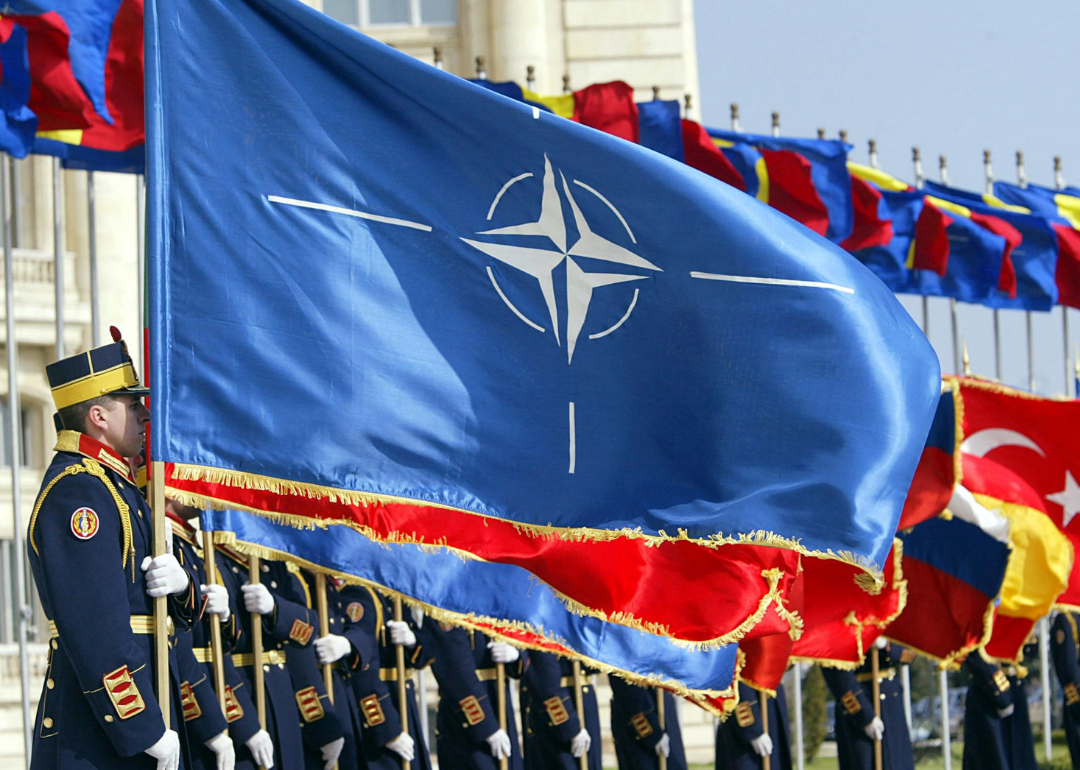
How NATO has grown since 1997 and its changing relationship with Russia
How NATO has grown since 1997 and its changing relationship with Russia
Since Russia invaded Ukraine in February 2022, Russian President Vladimir Putin has repeatedly cited three decades of North Atlantic Treaty Organization enlargement in Europe's Eastern bloc as one of several justifications for his unprovoked war. And while neither Russia nor Ukraine is a NATO member, the organization finds itself entangled in the conflict to prevent the escalation of Russian aggression beyond Ukraine's borders.
NATO was established in 1949, two years into the Cold War, by 10 democratic countries in Western Europe, the United States, and Canada. Its primary objective was to provide collective protection against attacks and influence from the Soviet Union. At the heart of this treaty is Article 5, which holds that an attack on one member country is considered an attack on all, and , which establishes an open-door policy for any European state that can further the mission and adhere to the founding tenets of NATO.
According to the treaty's charter, to become a NATO member, countries must have a functioning democratic political system based on a market economy; fair treatment of minority populations; a commitment to resolve conflicts peacefully; an ability and willingness to make military contributions to NATO; and a commitment to democratic civil-military relations and institutions. Even with those criteria met, all existing NATO members must reach a consensus on a country's application.
In response to the formation of this western alliance and democratization of Europe, particularly West Germany's admission into NATO in 1955, the Eastern bloc countries created the 鈥攁 communist counterbalance on the continent and an alliance between the USSR, Albania, Poland, Czechoslovakia, Hungary, Bulgaria, Romania, and East Germany.
Unlike NATO's spirit of agreement and a desire to preserve sovereign democracies, the Warsaw Pact was a treaty meant to protect and serve in the best interest of the Soviet Union. The pact included a provision allowing Soviet military presence and control in member countries鈥攁 condition that was exercised in Poland, Hungary, and Czechoslovakia to quash democratic uprisings.
By the mid-1980s, the influence and power of the Soviet Union began to deteriorate. Mikhail Gorbachev, as the new Communist Party Leader of the Soviet Union, proposed more liberal political and economic policies including glasnost (government transparency) and perestroika (economic restructuring) to kick-start a stagnant Soviet economy.
These changes fostered greater autonomy in Soviet satellite countries and increased freedom of political expression. They also drew harsh criticism from staunch Communist party members who viewed these ideological shifts as weaknesses. Instead of igniting an engine of prosperity as he had hoped, Gorbachev's bungled execution ultimately led to .
By 1991, the Warsaw Pact had ended, the Berlin Wall was torn down, and the Soviet Union collapsed. NATO remained in existence even without the threat of the Soviet Union because its mission to deter the rise of militant nationalism and to provide collective security to encourage the democratization of Europe was still relevant. Its existence eventually made way for the democratic pursuits of former Soviet satellite countries, most of whom would seek NATO membership in the coming decades.
From the perspective of Russia's ruling elite throughout history, the expansion of NATO is a threat to Russia's security and dominance鈥攅very neighboring country with a different ideology, and a NATO-backed military presence, creates the potential for conflict.
The served as a way to ease these concerns, transitioning from an adversarial relationship to a mutually beneficial alliance with the joint objective of European security. Among the agreement's most important points are that NATO expansion is not prohibited. Since then, more than 14 countries have been admitted into the alliance, with more seeking membership today.
Russia has largely condemned these admissions, accusing NATO of not to expand "one inch further east" and enforcing a policy of neo-containment, or ideological isolation. To better understand NATO's current role on the national stage amid the war in Ukraine, 麻豆原创 compiled the history of NATO membership changes since 1997 and how Russia reacted to the events of the era.
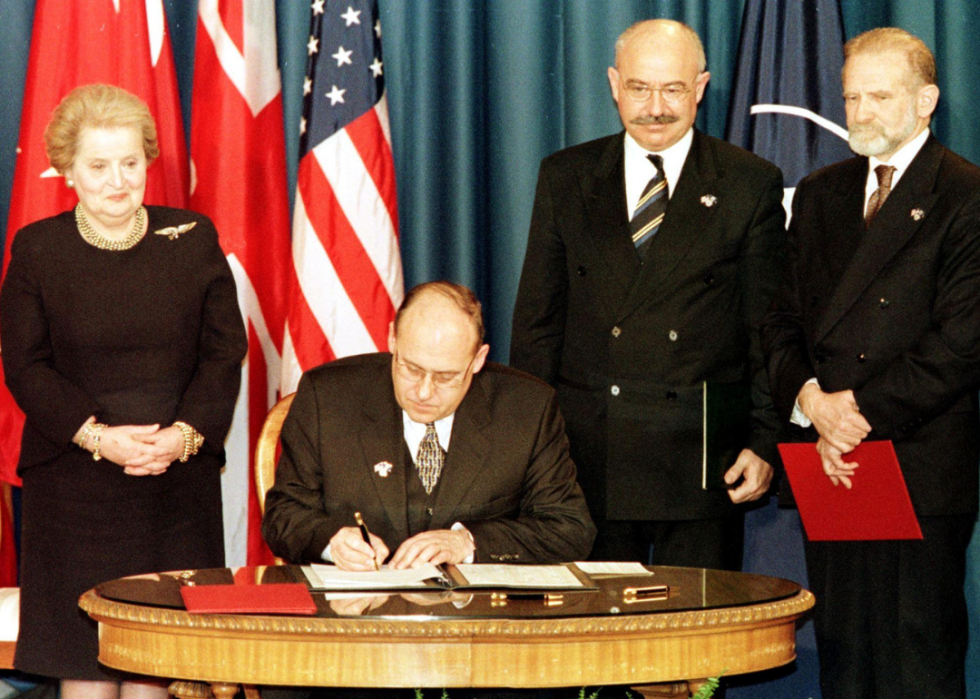
1999 new members: Hungary, the Czech Republic, and Poland
- Total NATO membership: 19
Poland, Hungary, and the Czech Republic were members of the , and were among the first formerly Communist countries to pledge a commitment to democratic ideals and a desire to join the European Union. NATO's admission of these countries in 1999 was the alliance's first expansion east of Germany鈥攁 breach, Russian leaders have since claimed, of a promise made by U.S. Secretary of State James Baker during the reunification of Germany that NATO would not expand one inch to the east.
At the time of their accession, Boris Yeltsin was approaching the end of his eight years in office as Russia's first President following the dissolution of the Soviet Union. During Yeltsin's tenure, NATO launched the which allowed non-NATO countries鈥攍ike former Soviet satellites in Central and Eastern Europe, including Russia鈥攖o collaborate with the alliance.
Yeltsin was amenable to the idea of the PfP during its inception in 1993. He viewed it as a replacement for NATO and an opportunity for all of Europe to work together with the goal of collective security鈥攐ne which did not exclude Russia. However, as , Yeltsin did not understand it was also a path to full NATO membership for participants who chose to meet those criteria. Yeltsin eventually condemned NATO's enlargement by way of Poland, Hungary, and the Czech Republic, claiming it breached the spirit of promises made not to expand as well as the spirit of inclusion provided by the PfP.

2004 new members: Bulgaria, Estonia, Latvia, Lithuania, Romania, Slovakia, Slovenia
- Total NATO membership: 26
The admission of the Baltic states鈥擡stonia, Latvia, and Lithuania鈥攂rought NATO to Russia's doorstep. Until that point, no NATO member had shared a land border with Russia. This group also marked the first former Soviet countries to join the alliance. With their accession, they were officially beyond Russia's sphere of influence, politically speaking.
Under Vladimir Putin's leadership, Russia initially objected to this enlargement, claiming a NATO military presence in a bordering country was a threat to Russia's national security. But ultimately, Baltic state membership鈥攅ven through the eyes of Putin鈥攚as a . The alliance made clear that any lack of formal border treaties鈥攚hich until then had been considered a non-starter for membership鈥攚ould in the case of the Baltic states be overlooked, as Russia's "stalling tactics to impair [their] candidacy" were all too clear to member nations. In 2000, Putin signed the which outlined a commitment to fostering "good-neighborliness and mutual cooperation" specifically with the Baltic states. Russia was more concerned about preserving its improving relationship with the West at this time than blocking their admission.
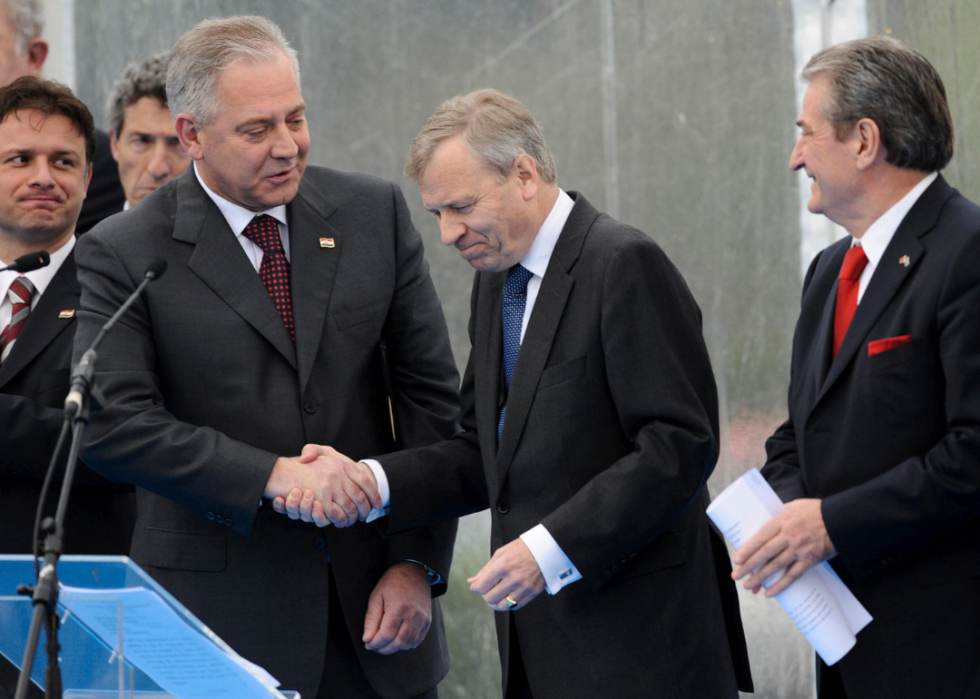
2009 new members: Albania and Croatia
- Total NATO membership: 28
Russia had no objections to NATO's admission of Albania and Croatia, though the former's admission could not have pleased the Russian Parliament given the long-standing differences between the two countries. Albania had been one of the original Warsaw Pact members. As early as 1956, the USSR's unwillingness to continue championing Stalinist ideology鈥攚hich had waned significantly following Stalin's death in 1953鈥攂egan to erode relations with Albania, specifically its Prime Minister Enver Hoxha, a staunch Stalin supporter. Hoxha openly condemned Soviet leader Nikita Khrushchev for his "" in which he denounced both the dictatorship of Stalin as well as the cult of personality that had fueled it.
Khrushchev cut aid to Albania in 1960 and 1961, and following the 1961 Warsaw Pact Summit, the USSR's and other member nations' embassies in Albania were closed and their ambassadors recalled. Consequently, Albania was de facto expelled from the pact, though it did not formally withdraw until 1968. Hoxha, who held power until his death in 1985, continued to operate what was essentially the only independent Communist nation in the Eastern bloc region.
Following the collapse of the Soviet Union, Albania joined the North Atlantic Cooperation Council (later the Euro-Atlantic Partnership Council) and then the PfP in 1994. Following the war in Kosovo鈥攚hich ran from February 1998 to June 1999鈥擜lbania's relationship with NATO began in earnest through humanitarian works and the establishment of civil-military cooperation. NATO opened the door to Albania's acceptance into the alliance in April 2008, and one year later, Albania became a formal member.
Croatia, on the other hand, had established diplomatic relations with the Russian Federation in 1992. Following from the former Yugoslavia in 1991, civil conflict erupted almost immediately between Serbs and Croats, requiring the intervention of the United Nations. The same year Croatia and Russia established relations, the country became involved in the war in Bosnia-Herzegovina. During that conflict, cooperation was established between NATO and Russian forces, a cooperation that would be during the later war in Kosovo. In 2002, a was established enabling Russia to work in partnership with member nations on "security issues of common interest."
At the time of Croatia's admittance to the alliance, this council remained in force, leaving little barrier or threat to Russia from NATO expansion. (This following Russia's annexation of Crimea.)
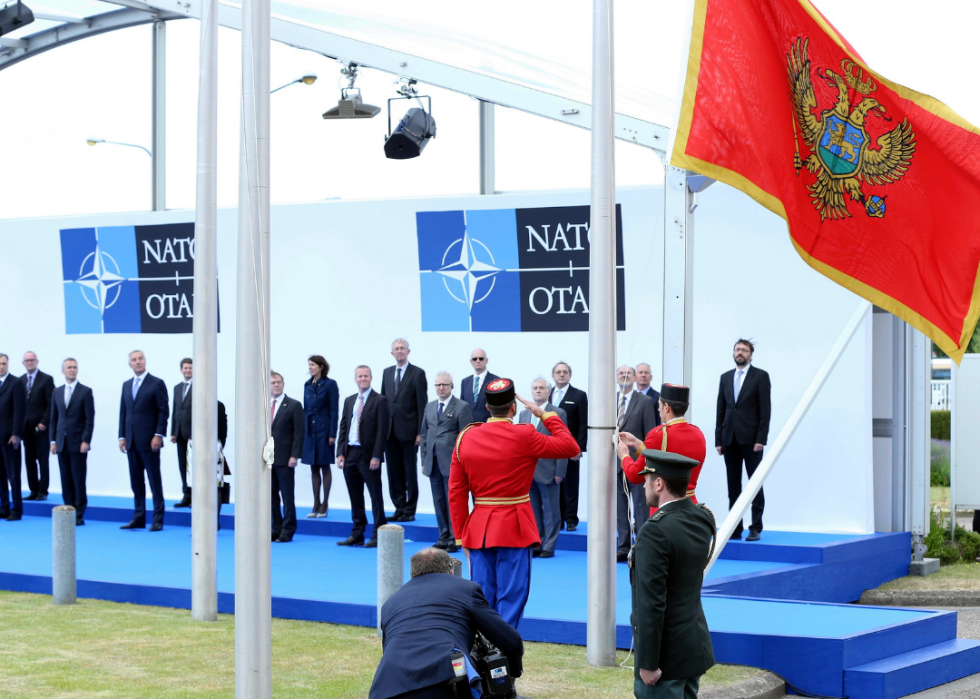
2017 new members: Montenegro
- Total NATO membership: 29
Montenegro's acceptance into NATO was met with fierce objection by Russia and among Montenegrins. Less than 20 years prior, the alliance bombed Montenegro鈥攚hich was then part of Yugoslavia鈥攄uring the Kosovo War after evidence was found of ethnic cleansing of Albanians.
While some residents were eager to ally themselves with the West despite the Kosovo bombings, others felt a deep cultural connection to Russia, with whom relations鈥攏ot mutually beneficial鈥攄ate back centuries.
Russia to thwart Montenegro's NATO membership, including fostering an anti-NATO alliance with the Serbian Church, becoming economically involved by accumulating property in the country and gaining political sway, and openly threatening retribution鈥攃alling it a provocation to Russia. Tensions rose further when Montenegro鈥攆ollowing suit with the EU鈥攊mposed sanctions on Russia for annexing Crimea in 2014. The crescendo came in 2016, when Russian nationalists attempted to assassinate Prime Minister Milo Djukanovic to install a pro-Russian government.
Russia followed through on its promise to retaliate against Montenegro if they joined NATO. Disinformation campaigns, import restrictions, and political blacklists are just some of the retaliatory tactics Russia has employed since 2017.
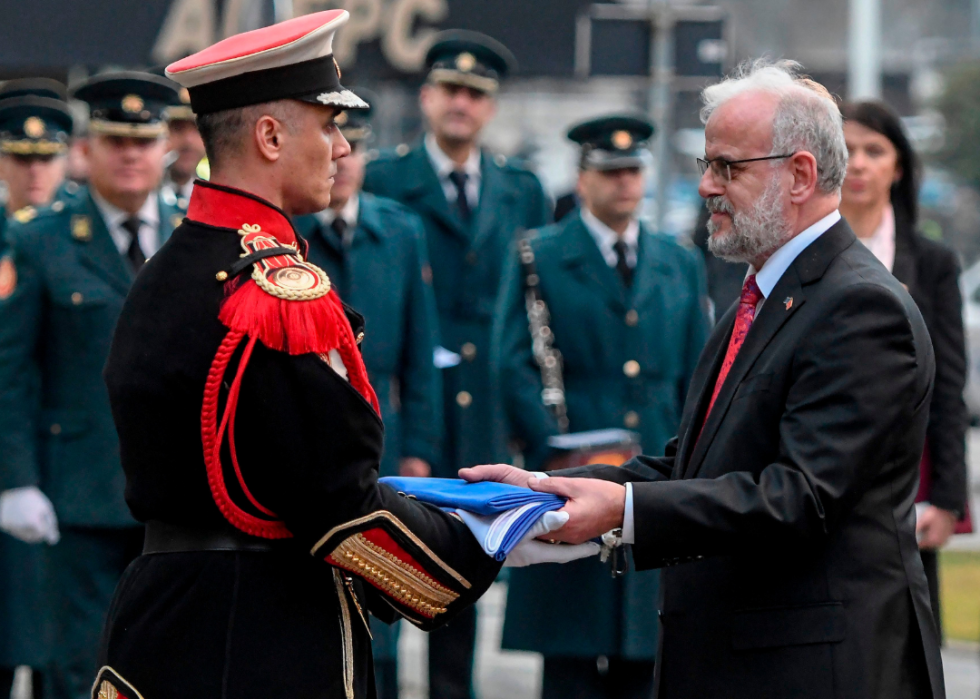
2020 new members: North Macedonia
- Total NATO membership: 30
Russia opposed North Macedonia's desire to join NATO, and in 2018 tried to between Greece and North Macedonia that would have cleared its path to membership. Eventually, Russia pivoted to open threats and provocations. North Macedonia has been identified as an easy target by and for Russia. The country is viewed by foes and allies alike as NATO's weakest link due to its small military, , and lack of economic integration into the EU.
Experts postulate that North Macedonia is the NATO bluff Russia is most likely to call. In other words, if Russia attacked, would NATO come to its aid? Persistent Russian meddling in the country and on its borders provides a glimpse of what the alliance must be ready to counteract should its defense mechanism be enacted. Troll farms spreading 鈥攕uch as accusing Albania and the West of attempting to install a pro-Albanian government in Macedonia鈥攈ave been heavily concentrated in North Macedonia, representing a modern type of attack that in its treaty.
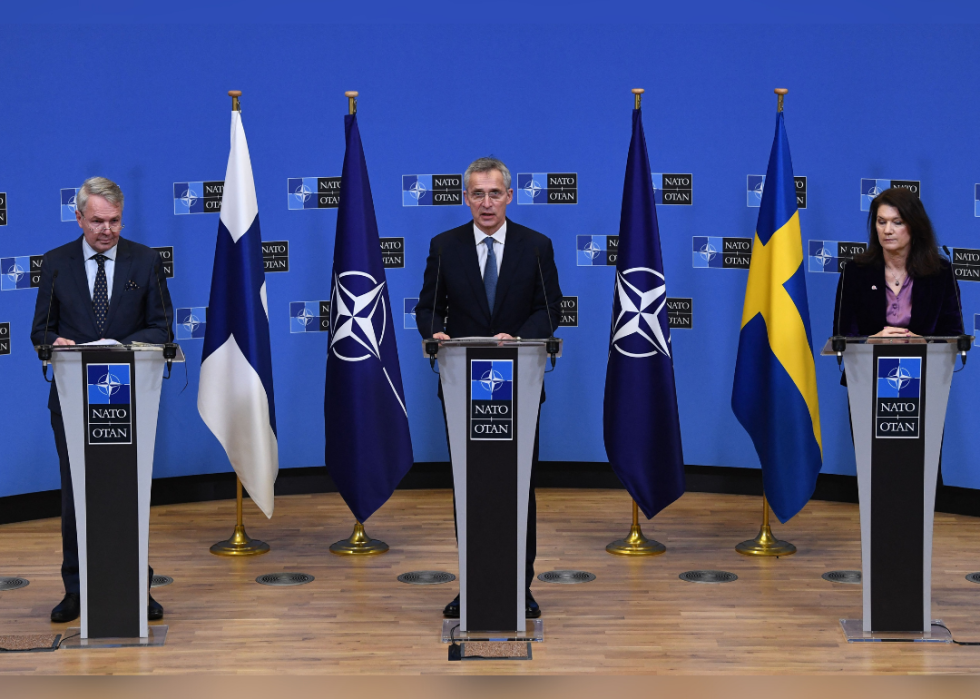
2022 aspiring members: Bosnia-Herzegovina, Finland, Georgia, Sweden, and Ukraine
- Potential NATO membership: 35
Russia's invasion of Ukraine has sparked interest in NATO membership. A flagrant disregard for sovereign borders has countries with long-standing non-military alignment鈥攕uch as Sweden and Finland鈥攕eeking the military protection and assurances of NATO. While both countries meet all membership criteria, reaching a consensus among current members鈥攕pecifically Turkey鈥攊s causing delays. Turkey's President Recep Tayyip Erdogan has accused both countries of and rejected their applications on those grounds. Kremlin spokesman Dmitry Peskov offered a vague threat that Russia would need to "" in Europe should these two countries join the alliance.
Russia made similar threats against Bosnia-Herzegovina in March 2022, citing their invasion of Ukraine as what they're willing to do if the country joins NATO. Igor Kalabukhov, Russia's ambassador to Bosnia-Herzegovina, stated "we have shown what we expect on the example of Ukraine. If there are threats, we will react," .
Over the last decade and a half, Russia has in Eastern Europe through military offensives and the carving out of pro-Russian territories in developing democracies like Georgia and Ukraine.
In 2008鈥攕ix months after NATO announced its intention to admit both Georgia and Ukraine as members in the future鈥擱ussia invaded Georgia, beginning the five-day Russo-Georgian War. This resulted in the breakaway regions of Russian-backed South Ossetia and Abkhazia.
In 2014, Russia illegally annexed Ukraine's Crimea region in the Russo-Ukrainian War. With these two events looming over NATO, the alliance opted not to admit either country for fear of Russian escalation in the region.
Historically, NATO membership was not something overwhelmingly supported by Ukrainian government officials or residents. In 2010, Ukrainian President Viktor Yanukovych submitted a law that for Ukraine, leaving the country鈥攊n theory more than practice鈥攏eutral.
Today, Ukraine鈥攗nder President Volodymyr Zelensky鈥攊s seeking immediate admission into NATO primarily as a means of securing military support from the alliance in their war against Russia. NATO members including the U.S. are attached to the admission of these contested regions.