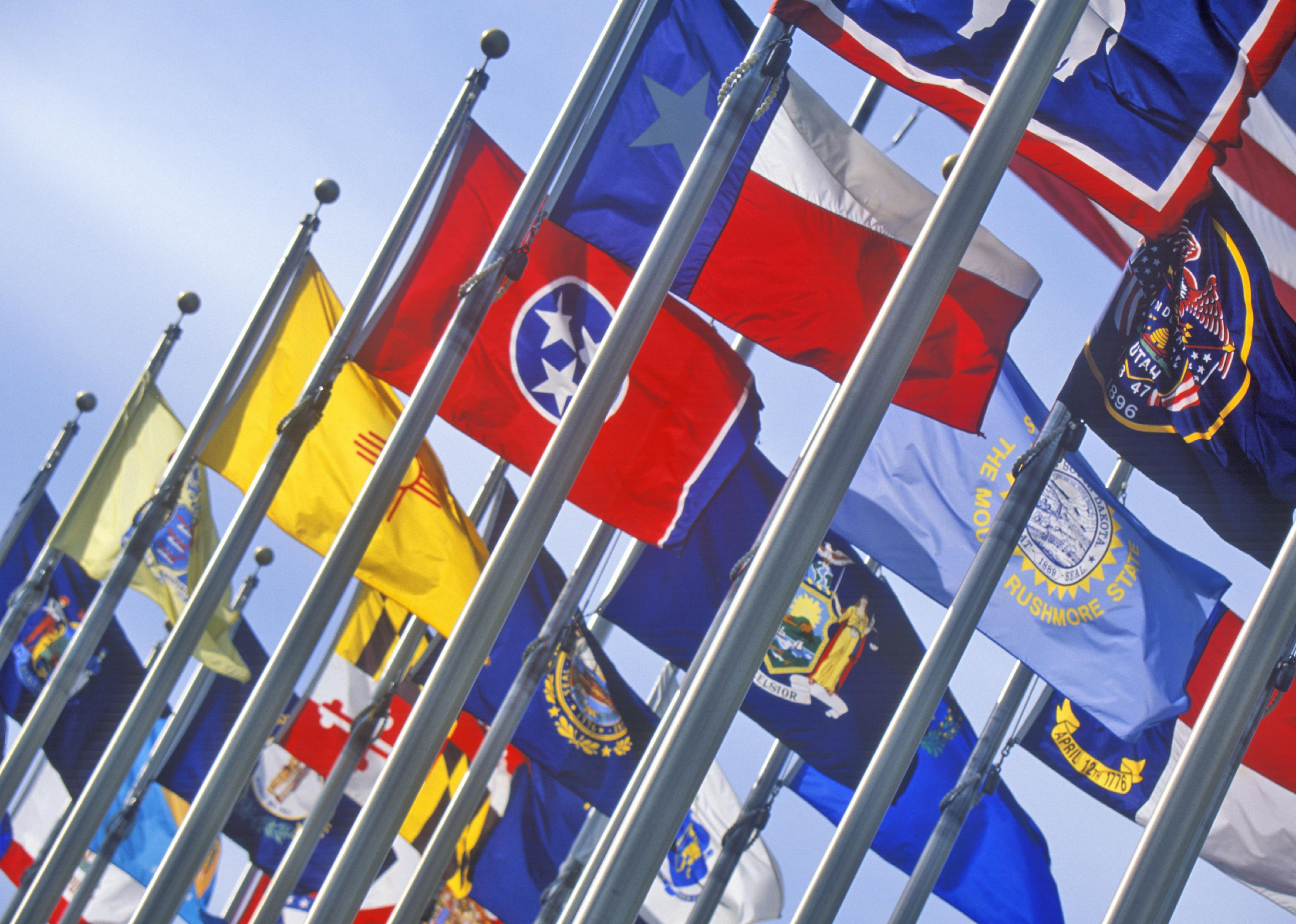
How many state flags do you know?
From fish and birds to flowers and even dinosaurs, America's 50 states choose all kinds of and contributions to the country. There are state gemstones, state songs, state amphibians, and state colors—but none carry the weight of the state flag. While Old Glory represents the country, that country is a collection of 50 unique and semi-autonomous cultures, and each one of them has a flag all their own.
are the result of elaborate contests while others were drafted through legislative haranguing. Some show off the state's official seal or famous animals. In some cases, symbolism is used to highlight the state's natural beauty or resources, while other flags use imagery to highlight important dates or to chronicle the state's leap from territory to full-fledged member of the Union. Still others represent ongoing controversy: , while Mississippi stands as the . Mississsippi's state legislature voted in June 2020 to update its official state flag and do away with the Confederate battle emblem for good.
Here's a look at all 50 of America's state flags, their histories, any changes they underwent over the years, and the stories that their images, colors, and symbols represent.
You may also like:
Flag #1
Flag #1: Alabama
One of the simplest designs of any state banner, the contains only a crimson cross in the shape of an "X" over a white background. According to state law, the flag can be square or rectangle, as long as the bars measure at least 6 inches across.
Flag #2
Flag #2: Alaska
The features the Big Dipper constellation, which is also called Ursa Major or Great Bear. The image, which was created by a 13-year-old child in an orphanage, also contains an image of the North Star, which for centuries guided sailors, explorers, hunters, and other adventurers who embody Alaska's wild spirit.
Flag #3: Arizona
The dates back to a rifle team that flew the banner during a competition in 1911, the year before the state was admitted to the Union. The 13 red and gold rays represent the powerful Southwestern desert sun, as well as the original 13 colonies.
Flag #4
Flag #4: Arkansas
The red, white, and blue color scheme of the is an homage to Old Glory, and the diamond shape that surrounds the state's name indicates that Arkansas is the only state in America where diamonds are mined. Below the state name are three stars, which represent France, Spain, and the United States, which all ruled the territory before it became a state. The single star above represents the Confederacy.
Flag #5
Flag #5: California
Few flags are more instantly recognizable than and its now-extinct California grizzly bear, which was first hoisted during the 1846 Bear Flag Revolt against Mexico. The flag was originally designed by a nephew of Mary Todd Lincoln, President Abraham Lincoln's wife.
Flag #6
Flag #6: Colorado
The dominant letter "C" in the clearly represents the state's name, but the meaning behind the flag's colors might not be so obvious. The two blue stripes are the same shade as the blue stripes on the American flag, as is the red that makes up the "C." The white represents the state's famous snowy mountains, blue represents its clear skies, gold represents the Colorado sun, and red is a tribute to the state's red soil.
Flag #7
Flag #7: Connecticut
The , which dates back to the late 19th century, is almost identical to the state's seal. A tribute to a memorial from the Connecticut chapter of the Daughters of the American Revolution, it's adorned with the state's motto: "qui transtulit sustinet" or "he who is transplanted still sustains."
Flag #8: Delaware
The borrows its color scheme from the uniform worn by George Washington, and the inclusion of Dec. 7, 1787 is in honor of the date that Delaware became a state—the very first in the Union. The Colonial-era imagery represents some of the people and things most closely associated with early Delaware, including militiamen, maize, water, oxen, farmers, and ships.
Flag #9
Flag #9: Florida
The original 1868 featured the state seal in the middle of a sea of white, but a governor thought it looked too much like a banner of truce when it sat idle on a windless day. In 1900, the flag was amended to include an Alabama-esque red cross.
Flag #10
Flag #10: Georgia
is new as of 2003, but change is nothing new in the Peach State—no other state has flown more variations of its official flag. The current incarnation features a square blue canton with 13 stars that represent the original colonies, as well as the words "In God We Trust" below the Georgia state seal.
Flag #11
Flag #11: Hawaii
More Great Britain than South Pacific, the is an obvious tribute to the United Kingdom's famous Union Jack. That's because several advisors to one of the last Hawaiian kings were British.
Flag #12
Flag #12: Idaho
The was adopted in 1907, and the highly specific, state-mandated rules and regulations regarding its dimensions and measurements are among the strictest in the country. Its central design is Idaho's state seal, which holds the distinction of being the only one in America designed by a woman.
Flag #13: Illinois
It was the efforts of the Daughters of the American Revolution that resulted in Illinois adopting its in 1915. It features an image of the state seal, as well as the Illinois state motto: “State sovereignty, national union.”
Flag #14
Flag #14: Indiana
The was adopted in 1917 shortly after the state celebrated its centennial anniversary. The torch symbolizes enlightenment and liberty, while the small stars represent the first 18 states. The large star represents the 19th state: Indiana itself.
Flag #15
Flag #15: Iowa
Truth, loyalty, purity, courage, and justice are represented on the by three vertical bars—one red, one blue, one white. The central image is an eagle carrying a banner emblazoned with the state's motto: “Our liberties we prize, and our rights we will maintain.”
Flag #16
Flag #16: Kansas
Chances are good you answered this one correctly—the word "Kansas," after all, is emblazoned across the front of the . The flag was adopted in 1927, but features images from the state seal, which was adopted all the way back in 1861. It includes symbolic imagery like a steamboat, rising sun, and plow horse.
Flag #17
Flag #17: Kentucky
One of the more recently adopted banners, the dates back only to 1962. The state seal is featured in the middle, as is the state's motto: “Together we stand, divided we fall.”
Flag #18
Flag #18: Louisiana
One of America's more peculiar banners is the , which features a pelican tearing open its own breast to nurture its young with its own blood: a behavior avian experts say the birds don't actually display. The flag is just one of 10 that have flown over official buildings in the state since the mid-to-late 1600s.
Flag #19
Flag #19: Maine
The Maine coat of arms dominates the , which was adopted more than a century ago in 1909. The seal honors the state's bountiful resources, and features the guiding light of the North Star, as well as the state's motto, Dirigo, which means "I lead."
Flag #20
Flag #20: Maryland
The state of Maryland traces its lineage to the Lords Baltimore, who founded the state. Among those nobles were the Crossland and Calvert families, whose ancient coats of arms still dominate the to this day.
Flag #21
Flag #21: Massachusetts
Both sides of the feature the state's coat of arms in the center of a pure white banner. Before it was approved in 1971, the opposite side of the flag was decorated with a green pine tree.
Flag #22
Flag #22: Michigan
Adopted in 1911, the depicts the state seal over a blue background. A moose and elk represent the state, and a bald eagle represents the nation. The flag also contains several symbolic Latin phrases, including e Pluribus Unum or "Out of many, one."
Flag #23
Flag #23: Minnesota
The state , which was adopted in 1907, features 19 stars, which denotes its status as American state #32—19 spots after the original 13. The North Star is also depicted, as are three dates: the year of statehood, the year an important military fort was established, and the year the state flag was adopted.
Flag #24
Flag #24: Mississippi
The features three horizontal bars, one red, one white and one blue, along with a canton of the Confederate flag in the upper-left corner. The Mississippi banner is the only remaining state to display the rebel battle flag outright; in June 2020 the state legislature voted to do away with the Confederate symbol on its state flag. Voters in the steate will deside on a new design in the 2020 election.
Flag #25
Flag #25: Missouri
Officially adopted in 1913, the uses red, white, and blue horizontal bars to represent justice, purity, and bravery. Along with the official state seal, the flag is decorated with 24 stars, which honors Missouri's status as America's 24th state.
Flag #26
Flag #26: Montana
is hard to miss, thanks to the large, all caps, yellow-on-blue spelling of "Montana" at the top. Each Helvetica bold font letter, all of which sit just above an image of the official state seal, measures exactly one-tenth the flag's height. Although Montana volunteers carried the flag in the Spanish-American war, the banner didn't officially represent the state until 1904.
Flag #27
Flag #27: Nebraska
Although it's modeled after a state seal from nearly a century before, the didn't become official until 1963, making the Midwestern state one of the last in America to designate an official flag. Stalks of corn, railroads, and the Rocky Mountains are just a few of the symbols found on the state seal, which dominate the entire flag.
Flag #28
Flag #28: Nevada
Nevada became a state in 1864, but didn't adopt an official flag until more than four decades had passed in 1905. The , which wasn't adopted until 1991, features sagebrush, Nevada's state flower, as well as the words "Battle Born," to remind the world it became a state during the Civil War.
Flag #29
Flag #29: New Hampshire
Another late bloomer that didn't adopt a flag until the 1900s is located across the country from Nevada in New England. It's New Hampshire, whose didn't become official until 1909. That notwithstanding, the Granite State is one of America's original 10. It became the ninth state to ratify the U.S. Constitution, a fact symbolized by nine stars surrounding the state seal on the flag.
Flag #30
Flag #30: New Jersey
The is dominated by the colors buff (a pale orange-brown) and Jersey blue, which George Washington preferred for the New Jersey military flag during the Revolutionary War. The colors, however, date all the way back to the region's Dutch settlers. Jersey blue and buff are now the official colors of the Garden State.
Flag #31
Flag #31: New Mexico
The red and yellow on the are the colors of Old Spain, which loomed large over the Southwest for decades. The lone image seen on the flag is the Zia sun symbol, which was sacred to the Zia Indians who once called the region home. The symbol also appears on the state quarter.
Flag #32
Flag #32: New York
Although New York State's coat of arms was established in 1778, the that displays it wasn't officially adopted until 1901. The image, which also appears on the state seal, features the Hudson River as a symbol of commerce along with the Latin word "Excelsior," which means "ever upward."
Flag #33
Flag #33: North Carolina
The flag flown in North Carolina during the Civil War remained unchanged until the 1880s, when the modern flag was adopted. That design endured for more than a century, when minor changes were made in 1991. The state's initials adorn the , as do large horizontal bars, one red, one white, along with important dates in state history.
Flag #34
Flag #34: North Dakota
The original 13 states are represented as individual stars on the . The name of the state appears on a banner, as does the American bald eagle with the Latin phrase "e Pluribus Unum" on a red scroll in the eagle's beak. It bears a striking resemblance to the flag North Dakota troops carried in the Spanish-American war.
Flag #35
Flag #35: Ohio
Ohio boasts one of the most unique state flags in the Union. More a burgee than an actual flag, the swallowtail design stands out from all 49 other state flags, which are either square or rectangular. Officially adopted in 1902, contains 17 stars—Ohio was the 17th state to join the Union—and the letter "O" for Ohio.
Flag #36
Flag #36: Oklahoma
Oklahoma went through 13 flags before the state adopted the in 1925. With colors and symbols representing devotion and defense, the flag pays homage to its Native American heritage, as well as its own lofty ideals, with images of both a peace pipe and an olive branch.
Flag #37
Flag #37: Oregon
Oregon holds the distinction of being the only state in the union with a that has different images on the front and back. Adopted in 1925, the back of the flag is decorated with an image of the state's official animal: the beaver. On the front is the state shield, complete with gold lettering on a navy blue background.
Flag #38
Flag #38: Pennsylvania
The state coat of arms dominates the , which dates all the way back to 1799. In 1907, however, lawmakers mandated that the flag's background must match the shade of blue found on Old Glory.
Flag #39
Flag #39: Rhode Island
The state motto "Hope" is displayed in gold on the white background of the —a motto likely drawn from a biblical quote. Adopted in 1877, the flag that flies over America's smallest state also pays homage to the original 13 colonies, as well as to the state's maritime culture with a gold anchor.
Flag #40
Flag #40: South Carolina
With history dating back to 1861, the is uncluttered and simple, dominated by a bold white image of the state tree: the Sabal palmetto. The crescent moon in the top left corner is an homage to the state's Revolutionary War troops, who were known for their crescent-shaped hats.
Flag #41
Flag #41: South Dakota
The official seal of South Dakota sits in the center of the and, unlike most states, the state's nickname (the Mount Rushmore State) completes the circle that includes the words "South Dakota." The flag includes the year 1899, which is when South Dakota became a state.
Flag #42
Flag #42: Tennessee
features three stars that represent the state's geographical divisions: east, west, and middle. The flag, which was designed by an infantryman and adopted in 1905, groups the three stars inside a white-bordered blue circle, which symbolizes endless continuity.
Flag #43
Flag #43: Texas
Arguably America's most famous state flag, the Lonestar State has flown the since 1839. The flag's lone star represents unity among the state's residents who, on special occasions, fly all six flags that have at one point or another flown over the state: France, Spain, Mexico, the Republic of Texas, the Confederate States of America, and the United States of America.
Flag #44
Flag #44: Utah
Two years are mentioned on the : 1847, when the Mormons came to Utah, and 1896, when the Western territory became a state. The state seal dominates the flag and includes the word "Industry," which represents the state's historic appreciation for hard work.
Flag #45
Flag #45: Vermont
The features the state coat of arms, which depicts a pastoral New England setting against a blue background. Adopted in 1919, the flag also includes the state motto: “Vermont; Freedom and Unity.”
Flag #46
Flag #46: Virginia
Like many other states, features the state's coat of arms on a blue background. It depicts the mythical Virtus, armed with a spear and a sword, trampling tyranny.
Flag #47
Flag #47: Washington
The pays homage to its namesake: none other than George Washington himself. Washington remains the only state flag in all of America that depicts a historical figure.
Flag #48
Flag #48: West Virginia
"Montani Semper Liberi" translates to "Mountaineers are Always Free." Those words, the motto of West Virginia, are emblazoned on the . The state seal sits in the middle of a white background with a blue border, and features a wreath of rhododendron—the state's official flower.
Flag #49
Flag #49: Wisconsin
Wisconsin was admitted into the Union in 1848, and the honors that year underneath an image of the state seal. Above the seal are the name of the state and the word "Forward," which honors the state's commitment to progress.
Flag #50
Flag #50: Wyoming
Wyoming was among the very last states to adopt a , with the official ratification not taking place until 1917. There were 37 entries, and the buffalo design developed up by a woman named Verna Keays won the design contest, earning Keays $20.