Looking back at 100 years of flight
The aerospace industry today is looking to push the boundaries of air travel in unprecedented ways. Airplane manufacturers like Boeing as well as up-and-coming startups have suggested work on supersonic air travel, almost 15 years after the last flight of , a turbojet-powered supersonic passenger airliner. Whereas a mere 50 years ago, the idea of traveling to a faraway destination required weeks or months, technology has developed in such a way today that the idea of going from does not seem so far-fetched.
With this in mind, 麻豆原创 took a look at how the last 100 years of flight in America has developed over time. To compile historical data on American aviation starting in the 1950s and 1960s, 麻豆原创 used information from the , the International Civil Aviation Organization and Civil Aviation Statistics of the World (), and the U.S. Defense Manpower Data Center ( and ).
Read on about the historical events in aviation that helped shape travel as it's known today.
RELATED: Click to see the cost of a plane ticket the year you graduated college
1917
Three years since the service took flight in 1914, the U.S. government decided to transport .
1918
On May 14, 1918, an left Long Island, New York for Washington D.C., with a stop in Philadelphia.
1919
, the Post Office used planes left over from World War I to make the starting leg of the first transcontinental air service, from Chicago to Cleveland.
1920
It wasn鈥檛 until that the aircraft managed the difficult challenge of flying past the Rocky Mountains and the route was fully completed. According to Avjobs, by using airplanes, 鈥渢he Post Office was able to shave 22 hours off coast-to-coast mail deliveries.鈥�
1921
Americans began trying to solve the issue of not being able to fly at night in 1921. That year, the over an 80-mile distance that were visible to pilots to guide them at night.
1922
The Army had originally taken charge of operating the beacons and overall guidance system, but the .
1923
The beacons were first placed between Columbus and Dayton, Ohio, and then in between Chicago and Cheyenne, Wyoming. This new system was at least two days faster than delivering mail by train.
1924
By mid-decade the Post Office was flying per year.
1925
In the first step toward the eventual privatization of the airline industry, the government , which allowed the government to transfer airmail to private companies.
1926
This year President Calvin Coolidge's government worked to develop a national aviation policy, which became the . This allowed the Secretary of Commerce to designate air routes, develop air navigation systems, license pilots and aircraft, and investigate accidents.
1927
On May 20, 1927, , from New York to Paris. It took 33 hours, 29 minutes, and 30 seconds.
1928
Lindbergh鈥檚 successful flight sparked excitement about the aviation industry, and in the two years following, .]
1929
The number of air passengers in the country鈥攚hich were mostly made up of businessmen鈥攇rew from a measly .
1930
鈥�known as the Watres Act鈥�that allowed the Post Office to base airmail rates on space or volume instead of weight.
1931
During this period, Postmaster General Walter Brown held meetings about consolidating airmail routes that many because they only invited a few larger airlines, excluding smaller ones.
1932
From 1928 through 1932, the plane used by most U.S. airlines was the , which had .
1933
Until the 1930s, airlines that touted routes solely for passenger travel . But in 1933 the first modern passenger airliner, the 10-passenger Boeing 247, was built.
1934
President Franklin Roosevelt sought to fix conflict among small and larger airlines by turning airmail back over to the Army, but too many accidents by pilots unfamiliar with routes caused the government to rethink this move. sought to return airmail transport to the private sector鈥攂ut this time with more regulations that forced companies to consider building up the passenger side of their businesses.
1935
was built in what is now New Jersey鈥檚 Newark International Airport.
1936
The with American Airlines as the first 21-person aircraft that made passenger air travel profitable. It became the most used plane in the country.]
1937
Pressurized cabins had not yet been developed, so many airlines had to deal with queasy passengers and .
1938
created the government鈥檚 Civil Aeronautics Authority, which helped regulate and instill order in the industry, as well as develop it long-term.
1939
When Hitler invaded Poland in 1939, were in the United States. That number exploded throughout the course of World War II to about the creation of 50,000 planes per year.
1940
The development of a few years before the war, and by 1940, radar transceivers along the U.K.鈥檚 east coast could detect German aircraft as it took off鈥攆rom mainland Europe.
1941
By this time, aboard aircraft to determine whether inbound planes were machines of allies or enemies.
1942
British pilot Frank Whittle in 1930 and 12 years later sent the first prototype to General Electric across the Atlantic.
1943
Thanks to Whittle鈥檚 design, , the Bell P-59, in 1943.
1944
In December of this year, the landmark by 54 nations in Chicago to continue the development of international air travel safely and orderly. The Chicago Convention also planned establishment of the International Civil Aviation Organization to support a growing global transport network.
1945
Lufthansa, after having been the airline to carry out the by a land-based aircraft in 1938, had its service suspended in 1945 due to the war. But it was given new life in 1953鈥�鈥�54.&苍产蝉辫;
1946
Strength of U.S. Air Force: 455,515 people
This year, Transcontinental and Western Airlines, known as " from Los Angeles to New York.
1947
Strength of U.S. Air Force: 305,827 people
On Sept. 18, 1947, .
1948
Strength of U.S. Air Force: 387,730 people
鈥�about half of them combat aircraft鈥�down from 68,400 aircraft at the end of the war in 1945.
1949
Strength of U.S. Air Force: 419,347 people
The United States from two to seven in 1949.
1950
Strength of U.S. Air Force: 411,277 people
President Harry S. Truman .
1951
Strength of U.S. Air Force: 788,381 people
The English Electric Canberra made the , taking a mere 4 hours, 37 minutes.
1952
Strength of U.S. Air Force: 983,261 people
The British jet 鈥淐omet鈥� flying from London to Johannesburg, South Africa.
1953
Strength of U.S. Air Force: 977,593 people
The 鈥�50s were a time in which passengers paid what many would consider exorbitant prices for in-flight luxuries. A one-way flight to Europe was known to be in today's dollars.
1954
Strength of U.S. Air Force: 947,918 people
According to the Huffington Post, a 鈥渕andated that stewardesses be single, stay under 125 pounds, and maintain 鈥榟igh moral standards鈥� during employment.鈥�
1955
Strength of U.S. Air Force: 959,946 people
Passengers during this time also to fly and could get to the airport before takeoff.
1956
Strength of U.S. Air Force: 909,958 people
The rapid boom in the industry led to overcrowded airspace. In fact, in 1956 over the Grand Canyon, killing 128 people.
1957
Strength of U.S. Air Force: 919,835 people
Another luxury of 鈥�50s air travel was space鈥攅conomy was more like today鈥檚 business class, with 3鈥�6 inches more legroom than what passengers get today.
1958
Strength of U.S. Air Force: 871,156 people
The number of accidents caused by overcrowdedness led to Congress鈥檚 passage of and establishment of the Federal Aviation Agency, a safety regulatory agency.
1959
Strength of U.S. Air Force: 840,435 people
A journalist from June of 1959, which stated that the price of a 12-hour trip from Los Angeles to New York cost $168.40鈥�$1,225 when adjusted for inflation.
1960
Strength of U.S. Air Force: 814,752 people
In 1960, in the U.S. after winning a discrimination case against Capital Airlines. Ruth Carol Taylor was actually the first African-American flight attendant, which occurred as a response after Banks brought suit against the airline.
1961
Strength of U.S. Air Force: 821,151 people
was done by Antulio Ramirez Ortiz using a gun and a steak knife. He rerouted the plane to Key West, Florida, to Havana, Cuba, as he had said that he was trying to warn Cuban President Fidel Castro that he was being targeted for assassination.
1962
Strength of U.S. Air Force: 884,025 people
in an aircraft, when a helicopter was shot down by enemy troops in Vietnam.
1963
Strength of U.S. Air Force: 869,431 people
In a plane crash near Camden, Tennessee, , Cowboy Copas, Hawkshaw Hawkins, and one more person were killed.
1964
Average domestic airline fare: $36.66 (inflation-adjusted: $289.36)
Strength of U.S. Air Force: 856,798 people
On April 11, 1964, to successfully pilot a plane around the world.
1965
Average domestic airline fare: $36.81 (inflation-adjusted: $285.97)
Strength of U.S. Air Force: 824,662 people
On March 18, 1965, took the first space walk.
1966
Average domestic airline fare: $36.81 (inflation-adjusted: $277.17)
Strength of U.S. Air Force: 887,353 people
The and could now carry hundreds of people, further revolutionizing mass air transport.
1967
Average domestic airline fare: $36.97 (inflation-adjusted: $270.83)
Strength of U.S. Air Force: 897,494 people
In October, on the planet Venus.
1968
Average domestic airline fare: $37.74 (inflation-adjusted: $265.37)
Strength of U.S. Air Force: 904,850 people
In December, Frank Borman, James Lovell, and William Anders became the .
1969
Average domestic airline fare: $40.52 (inflation-adjusted: $270.20)
Strength of U.S. Air Force: 862,353 people
This year marked the history-altering date when first humans, , landed on the moon.
1970
Number of passengers carried: 163,448,992 people
Average domestic airline fare: $43.77 (inflation-adjusted: $276.06)
Strength of U.S. Air Force: 791,349 people
Pan American World Airway鈥檚 seated as many as 450 passengers. It was 80% bigger than the largest jet up until that time, called the DC-8.
1971
Number of passengers carried: 174,143,104 people
Average domestic airline fare: $46.87 (inflation-adjusted: $283.16)
Strength of U.S. Air Force: 755,300 people
its first transatlantic journey.
1972
Number of passengers carried: 191,325,408 people
Average domestic airline fare: $48.10 (inflation-adjusted: $281.60)
Strength of U.S. Air Force: 725,838 people
The National Aeronautics and Space Administration, known as for the first time.
1973
Number of passengers carried: 202,309,200 people
Average domestic airline fare: $49.80 (inflation-adjusted: $274.49)
Strength of U.S. Air Force: 691,182 people
as the first female pilot hired for a commercial airline鈥�Frontier Airlines.
1974
Number of passengers carried: 207,612,400 people
Average domestic airline fare: $53.98 (inflation-adjusted: $267.93)
Strength of U.S. Air Force: 643,970 people
to qualify as a pilot for the U.S. Army.
1975
Number of passengers carried: 204,900,400 people
Average domestic airline fare: $58.78 (inflation-adjusted: $267.33)
Strength of U.S. Air Force: 612,751 people
In a show of peace, 鈥�known as the Apollo-Soyuz Test Project鈥�took place.
1976
Number of passengers carried: 223,017,296 people
Average domestic airline fare: $63.57 (inflation-adjusted: $273.39)
Strength of U.S. Air Force: 585,416 people
In this year alone, 鈥�first planet landing鈥�with Viking 1 and 2.
1977
Number of passengers carried: 240,144,992 people
Average domestic airline fare: $67.28 (inflation-adjusted: $271.69)
Strength of U.S. Air Force: 570,695 people
A horrific accident between a caused 234 and 317 passenger deaths, respectively, as well as 14 crew members of the KLM plane.
1978
Number of passengers carried: 273,025,504 people
Average domestic airline fare: $70.38 (inflation-adjusted: $264.13)
Strength of U.S. Air Force: 569,712 people
With the , Congress ended the government鈥檚 regulation of airline prices and routes.
1979
Number of passengers carried: 313,624,000 people
Average domestic airline fare: $76.10 (inflation-adjusted: $256.49)
Strength of U.S. Air Force: 559,455 people
Congress passed the , providing resources to assure more safety and quiet flights.
1980
Number of passengers carried: 295,329,088 people
Average domestic airline fare: $105.18 (inflation-adjusted: $312.34)
Strength of U.S. Air Force: 557,969 people
The , the Solar Challenger, which was designed by American , flew successfully.
1981
Number of passengers carried: 281,086,400 people
Average domestic airline fare: $132.40 (inflation-adjusted: $356.42)
Strength of U.S. Air Force: 570,302 people
The following year, the 163 miles across the English Channel.
1982
Number of passengers carried: 290,992,608 people
Average domestic airline fare: $146.01 (inflation-adjusted: $370.25)
Strength of U.S. Air Force: 582,845 people
The was completed by Americans H. Ross Perot Jr. and Jay Coburn.
1983
Number of passengers carried: 315,600,096 people
Average domestic airline fare: $154.36 (inflation-adjusted: $379.25)
Strength of U.S. Air Force: 592,044 people
This year was of the aviation industry: Guy Bluford became the first African-American astronaut and Sally Ride became the first American female astronaut.
1984
Number of passengers carried: 340,191,488 people
Average domestic airline fare: $163.64 (inflation-adjusted: $385.41)
Strength of U.S. Air Force: 597,125 people
made the solo transatlantic balloon flight, from Carbon, Maine, to Savona, Italy.
1985
Number of passengers carried: 372,059,104 people
Average domestic airline fare: $174.01 (inflation-adjusted: $395.72)
Strength of U.S. Air Force: 601,515 people
This year marked the .
1986
Number of passengers carried: 414,554,496 people
Average domestic airline fare: $181.12 (inflation-adjusted: $404.39)
Strength of U.S. Air Force: 608,199 people
On Jan. 28, 1986, the killed seven astronauts. Later investigations revealed it wasn't exactly an explosion: "."
1987
Number of passengers carried: 441,832,704 people
Average domestic airline fare: $189.94 (inflation-adjusted: $409.14)
Strength of U.S. Air Force: 607,035 people
in February of this year.
1988
Number of passengers carried: 454,202,912 people
Average domestic airline fare: $192.10 (inflation-adjusted: $397.36)
Strength of U.S. Air Force: 576,446 people
Despite the harrowing event of the Challenger incident two years prior, made its first flight.
1989
Number of passengers carried: 453,161,504 people
Average domestic airline fare: $203.55 (inflation-adjusted: $401.68)
Strength of U.S. Air Force: 570,880 people
The first satellite to measure radiation named Cosmic Background Explorer, was launched.
1990
Number of passengers carried: 464,574,016 people
Average domestic airline fare: $229.54 (inflation-adjusted: $429.74)
Strength of U.S. Air Force: 535,233 people
was deployed in April of 1990, which NASA says 鈥�.鈥�
1991
Number of passengers carried: 452,015,904 people
Average domestic airline fare: $240.05 (inflation-adjusted: $431.28)
Strength of U.S. Air Force: 510,432 people
as the first female crew member of the SR-71 Blackbird.
1992
Number of passengers carried: 466,964,992 people
Average domestic airline fare: $240.05 (inflation-adjusted: $418.68)
Strength of U.S. Air Force: 470,315 people
In May, the , allowing the first three-person spacewalk.
1993
Number of passengers carried: 469,926,112 people
Average domestic airline fare: $276.40 (inflation-adjusted: $468.06)
Strength of U.S. Air Force: 444,351 people
On April 28, 1993, the U.S. Secretary of Defense were permitted to enter combat.
1994
Number of passengers carried: 514,924,000 people
Average domestic airline fare: $286.92 (inflation-adjusted: $473.75)
Strength of U.S. Air Force: 426,327 people
Vicki Van Meter to pilot a transatlantic flight at 12 years old.
1995
Number of passengers carried: 533,512,096 people
Average domestic airline fare: $293.42 (inflation-adjusted: $471.12)
Strength of U.S. Air Force: 400,409 people
into service, the longest long-range wide-body twin jets in the world.
1996
Number of passengers carried: 571,072,000 people
Average domestic airline fare: $278.68 (inflation-adjusted: $434.62)
Strength of U.S. Air Force: 389,001 people
Astronaut Shannon Lucid for the longest stay in space at more than two years.
1997
Number of passengers carried: 590,571,392 people
Average domestic airline fare: $288.39 (inflation-adjusted: $439.69)
Strength of U.S. Air Force: 377,385 people
NASA's Mars Pathfinder and Sojourner Rover for the first time in order to perform geological research.
1998
Number of passengers carried: 588,170,880 people
Average domestic airline fare: $307.77 (inflation-adjusted: $462.03)
Strength of U.S. Air Force: 367,468 people
The Hubble Space Telescope, launched eight years before, of a planet outside of Earth鈥檚 solar system.
1999
Number of passengers carried: 634,364,608 people
Average domestic airline fare: $325.71 (inflation-adjusted: $478.40)
Strength of U.S. Air Force: 360,510 people
The with AirTran Airways, with twin engines and a single aisle.
2000
Number of passengers carried: 665,327,414 people
Average domestic airline fare: $339.62 (inflation-adjusted: $482.60)
Strength of U.S. Air Force: 355,601 people
In November 2000, Commander Yuri Gidzenko, Commander Bill Shepherd, and flight engineer Sergei Krikalev became the on the International Space Station.
2001
Number of passengers carried: 622,187,846 people
Average domestic airline fare: $324.20 (inflation-adjusted: $447.94)
Strength of U.S. Air Force: 363,692 people
, the International Space Station celebrated its first birthday, and Polly Vacher became the first woman to travel around the world in a small plane via the Pacific Ocean.
2002
Number of passengers carried: 598,410,415 people
Average domestic airline fare: $314.78 (inflation-adjusted: $428.17)
Strength of U.S. Air Force: 369,112 people
On Nov. 26, 2002, Commander John B. Herrington became the to take a space walk, thanks to the space shuttle Endeavour.
2003
Number of passengers carried: 588,997,110 people
Average domestic airline fare: $316.21 (inflation-adjusted: $420.52)
Strength of U.S. Air Force: 375,859 people
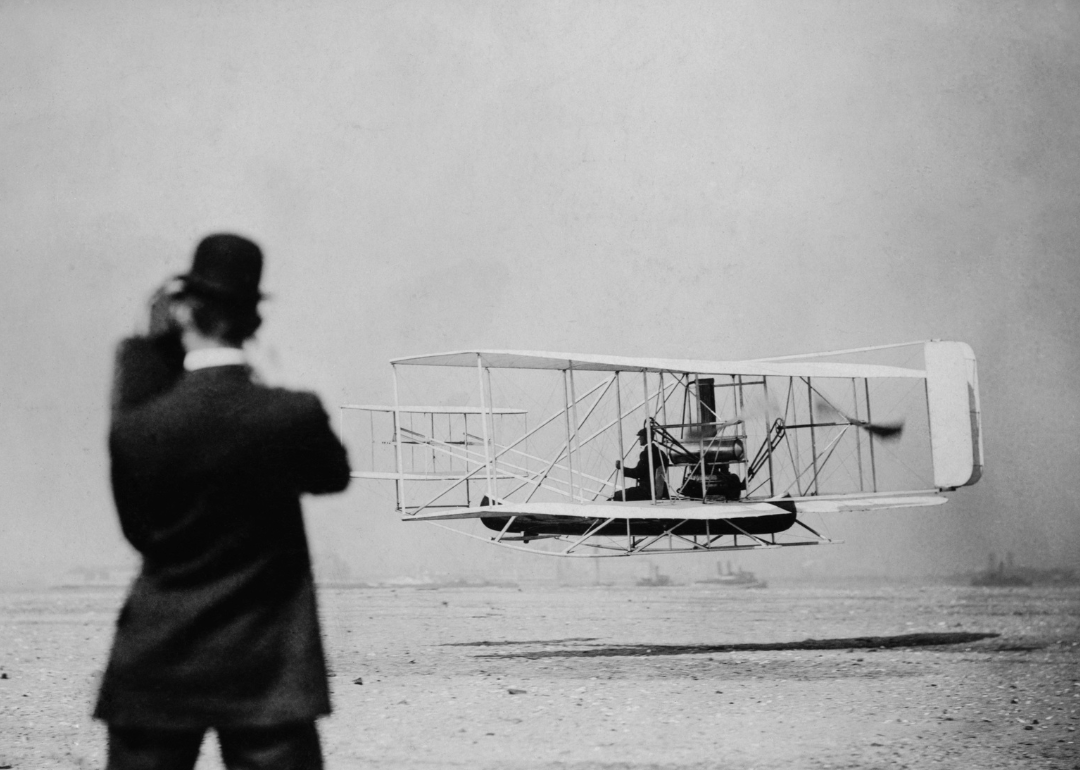
The Concorde made its on Oct. 24, 2003. This year also marked the 100th anniversary of the first controlled flight.
2004
Number of passengers carried: 678,110,608 people
Average domestic airline fare: $308.09 (inflation-adjusted: $399.10)
Strength of U.S. Air Force: 376,813 people
shared his vision for the future of NASA and space exploration, which included plans to retire the International Space Station by 2010 and return to the moon by 2020. Ultimately, President Bush said, the next steps would be 鈥渉uman missions to Mars and to worlds beyond.鈥�
2005
Number of passengers carried: 720,547,738 people
Average domestic airline fare: $307.54 (inflation-adjusted: $385.33)
Strength of U.S. Air Force: 353,696 people
The world record for the was set by a Boeing 777-200LR Worldliner. It flew from Hong Kong to London in 22 hours and 42 minutes.
2006
Number of passengers carried: 725,530,965 people
Average domestic airline fare: $327.91 (inflation-adjusted: $398.01)
Strength of U.S. Air Force: 348,953 people
The International Space Station , Anousheh Ansari, on board for eight days. She was doing human physiology tests for the European Space Agency.
2007
Number of passengers carried: 744,302,310 people
Average domestic airline fare: $324.57 (inflation-adjusted: $383.12)
Strength of U.S. Air Force: 333,495 people
for Singapore Airlines as the largest commercial airplane in the world, making its first stops in New York and Los Angeles.
2008
Number of passengers carried: 701,779,551 people
Average domestic airline fare: $343.02 (inflation-adjusted: $389.86)
Strength of U.S. Air Force: 327,382 people
This year was . The Expedition 16鈥檚 return marked the first time women were the dominant sex on a spacecraft, with Commander Peggy Whitson, flight engineer Yuri Malenchenko, and spaceflight participant So-yeon Yi on board. Whitson was the first female commander of the International Space Station and broke the record for the longest time spent in space for a U.S. astronaut鈥�377 days.
2009
Number of passengers carried: 679,423,408 people
Average domestic airline fare: $311.46 (inflation-adjusted: $355.31)
Strength of U.S. Air Force: 333,408 people
the Hubble Space Telescope鈥檚 last servicing mission and the last non-International Space Station shuttle flight.
2010
Number of passengers carried: 720,497,000 people
Average domestic airline fare: $334.93 (inflation-adjusted: $375.77)
Strength of U.S. Air Force: 334,198 people
and achieved Earth orbit during the summer of 2010, instilling confidence in the future of a privatized aerospace industry.
2011
Number of passengers carried: 730,796,000 people
Average domestic airline fare: $364.41 (inflation-adjusted: $396.49)
Strength of U.S. Air Force: 333,162 people
July 8, 2011 saw the final journey of space shuttle Atlantis, marking the .
2012
Number of passengers carried: 736,699,000 people
Average domestic airline fare: $376.62 (inflation-adjusted: $401.39)
Strength of U.S. Air Force: 332,834 people
In September 2012, space shuttle Endeavour on top of a Boeing 747 from Florida to Los Angeles, effectively ending the 30-year NASA shuttle program.
2013
Number of passengers carried: 743,171,000 people
Average domestic airline fare: $379.99 (inflation-adjusted: $399.08)
Strength of U.S. Air Force: 330,485 people
The Airbus A350 while more than 10,000 spectators watched, ending eight years of service and costing about $15 billion.
2014
Number of passengers carried: 762,710,000 people
Average domestic airline fare: $390.54 (inflation-adjusted: $403.74)
Strength of U.S. Air Force: 316,332 people
in 2014 called the New Commercial Spaceflight Initiative. This would allow companies to have more access and use of NASA鈥檚 resources in order to further the U.S. aerospace industry and objectives.
2015
Number of passengers carried: 798,222,000 people
Average domestic airline fare: $378.43 (inflation-adjusted: $390.73)
Strength of U.S. Air Force: 311,357 people
were taken by New Horizons as it conducted a flyby, revealing that the 鈥減lanet鈥� was larger than was believed.
2016
Number of passengers carried: 824,039,000 people
Average domestic airline fare: $352.42 (inflation-adjusted: $359.32)
Strength of U.S. Air Force: 317,883 people
The United Nations' International Civil Aviation Organization in an effort to address climate change. Later in the year, to land a spent rocket booster on a ship at sea after four unsuccessful attempts.
2017
Number of passengers carried: 849,403,000 people
Average domestic airline fare: $347.86 (inflation-adjusted: $347.86)
Strength of U.S. Air Force: 322,787 people
In 2017, consumers used and benefited from air travel more than ever, and spent about 1% of the world gross domestic product on air transport, . In addition, for commercial passenger air travel, with zero accident deaths.